
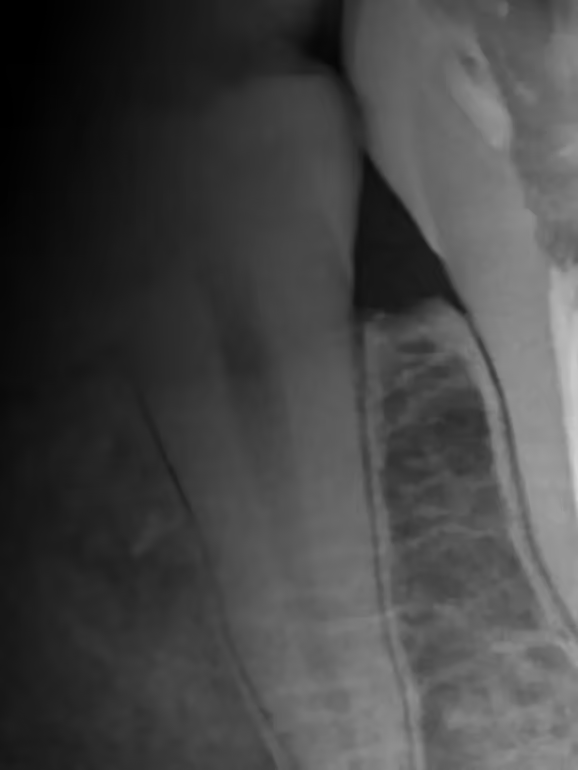
Patients ask about the price of the procedure, but the bill is only complete once the tooth has been restored. This is the most common misunderstanding on the subject. Root canal treatment deals with the problem inside the tooth, but it does not rebuild the crown of the tooth – and it is this second stage that is often more expensive than the first.
This article breaks the cost down into its parts. You will find the prices of the procedure itself and a list of what they include. After that comes a sample cost estimate for saving a molar, and a comparison with extracting the tooth and replacing it with an implant.
How much does root canal treatment cost at Flow Dental Studio?
At Flow Dental Studio the price depends on the number of canals in the tooth being treated. Treatment of a single-canal tooth costs 1500 PLN, and of a multi-canal tooth 2000 PLN. Both prices cover the complete procedure, carried out under a microscope.
Retreatment is priced higher: 2000 PLN for a single-canal tooth and 3000 PLN for a multi-canal tooth. Removing a broken instrument from a canal is a separate procedure costing 1000 PLN.
For comparison, root canal treatment at private practices in Poland costs from 700 PLN to 3000 PLN. In many places, the cost starts at 790 PLN for a single-canal tooth. Root canal treatment of molars can cost up to 1800 PLN, and in the largest cities prices for an incisor start at 1500 PLN. The range comes down to exactly what is included in the price.
| What | Cost |
|---|---|
| Root canal treatment, single-canal tooth | 1500 PLN |
| Root canal retreatment | from 1000 PLN |
| Simple extraction | 650 PLN |
What determines the price of root canal treatment?
The final price of root canal treatment depends on the number of canals and how complex the case is. These are two separate factors, because complexity does not follow directly from the number of canals. A tooth may have three straightforward canals, or two, one of which is calcified and curved.
- the number of canals and their anatomy,
- the position of the tooth in the arch and how easy it is to access,
- the treatment method, which affects the cost just as the technology used does,
- the need for additional procedures, such as removing broken instruments,
- the condition of the tooth before treatment, including advanced inflammation, because the amount of work depends on the condition of the tooth,
- additional costs: diagnostics, X-rays and restoration once treatment is complete.
The cost of root canal treatment can vary significantly between patients, even when the procedure has the same name in the price list. That is why planning should be based on a detailed cost estimate prepared after diagnostics, not an estimate given over the phone.
Number of canals and position of the tooth
Teeth differ in their anatomy in terms of the number of canals. Front teeth – incisors and canines – usually have one canal. Premolars have one or two, and molars three, four, sometimes more.
The number of canals in a tooth has a direct effect on the cost of treatment, because each one has to be shaped, irrigated and tightly sealed separately. Then there is access: working on the last molar is harder than on a front incisor, even though the procedure has the same name.
Atypical canals form a separate category, for example the MB2 canal in upper molars. Finding it requires magnification and often a CBCT scan, and missing it can cause the whole treatment to fail.
The dentist's experience and equipment
The dentist's experience affects how long the procedure takes and how many difficult cases can be completed without referring the patient elsewhere. The location and prestige of the practice also influence the price of root canal treatment, as does the cost of maintaining the equipment.
Private practices in large cities charge more for root canal treatment than those in smaller towns. This reflects rent, equipment and staff, not the name of the city itself.
Primary root canal treatment vs retreatment (re-endo)
Primary root canal treatment applies to a tooth that has not had root canal treatment before. Retreatment, known as re-endo, comes into play when previous treatment has not worked or the tooth has become reinfected.
Re-endo is more time-consuming than primary root canal treatment and requires greater precision and expertise. Retreatment involves removing the old filling from the canals, and only then can they be cleaned again. There are obstacles along the way: hard cements, perforations in the root wall and fragments of broken instruments.
On the market, root canal retreatment costs from 1000 PLN upwards; with us it is 2000 PLN for a single-canal tooth and 3000 PLN for a multi-canal tooth. The difference compared with primary treatment reflects the extra work, not a different procedure.
Root canal treatment under a microscope: how does it affect the price?
A microscope increases the cost of root canal therapy, because working under a microscope demands more precision and time. On the market, adding magnification raises the price by 200 to 600 PLN. With us, the microscope is not a separate item but part of every root canal procedure.
Magnification makes the procedure more precise and more effective. A microscope allows the canals to be thoroughly cleaned of pulp, additional canals to be found and the walls of the pulp chamber to be checked for microcracks.
We work with a ZEISS Extaro 300 microscope. Zeiss microscopes are widely used in modern endodontics and provide magnification together with illumination of the treatment area, without which some structures remain invisible. Root canal treatment under a microscope also makes re-endo more successful, because removing old material and broken instruments without magnification is often impossible.
What does the cost of root canal treatment include, and what costs extra?
The amount shown in the price list covers the procedure itself. It is worth knowing what it includes, so that comparisons with other offers make sense.
The price of the procedure usually includes local anaesthetic, placing a rubber dam to isolate the tooth, and mechanical shaping of the canals. On top of that come ultrasonically activated irrigation, filling the canals with gutta-percha and a temporary filling.
The consultation with a treatment plan, imaging and the final restoration are charged separately. Additional costs may include anaesthetic and X-rays, if a practice does not include them in the price of the procedure. When comparing price lists, it is therefore worth checking what is covered, not just the figure.
Restoring a root-treated tooth: the second part of the bill
Restoring a tooth after root canal treatment often involves additional costs, and it is this that determines the size of the whole bill. The crown of a permanent tooth without its pulp is more brittle, so sealing the canals alone does not protect it. The final cost depends on how much tooth structure needs to be rebuilt.
- a composite filling if the crown of the tooth is only slightly damaged,
- a build-up on a fibreglass post for 1000 PLN, when the cavity is larger,
- a composite endocrown for 1500 PLN or an all-ceramic one for 2000 PLN,
- an all-ceramic crown from 3000 PLN, i.e. a prosthetic crown when the whole of the tooth above the gum is destroyed,
- a cast post and core for 1000 PLN, with the use of a post and core decided after assessing the walls of the tooth.
In front teeth, where appearance matters, the restoration is sometimes completed with a porcelain or composite veneer, colour-matched to the neighbouring teeth. If the fracture runs deep below the gum line, crown lengthening may be needed first so that a well-sealed restoration is possible at all.
Conservative dentistry therefore covers only part of this pathway. The rest belongs to prosthodontics and is priced separately.
Sample cost estimate: root canal treatment of a molar
The simulation below shows the full bill for a multi-canal tooth with a prosthetic restoration. The amounts come from our price list.
| Item | Price |
|---|---|
| CBCT scan of the upper or lower jaw | 250 PLN, |
| scan report | 200 PLN, |
| treatment of a multi-canal tooth under a microscope | 2000 PLN, |
| build-up on a fibreglass post | 1000 PLN, |
| multilayered all-ceramic crown | from 3000 PLN. |
In total, that comes to 6450 PLN or more. It is clear that the root canal procedure itself accounts for less than a third of the total, and that the overall cost of treatment includes diagnostics and restoring the tooth. In simpler cases, where a composite filling is enough, the total is much lower.
Root canal treatment or extraction: which is better value?
Extracting the tooth looks cheaper at the moment you decide. A simple extraction costs 650 PLN compared with 2000 PLN for treating a multi-canal tooth, so the difference is obvious straight away.
The sums change a few months later, when the gap needs filling. Implant placement starts at 3400 PLN, and a screw-retained crown on an individual or hybrid abutment costs 4500 PLN. Together with the extraction, that comes to over 8500 PLN, and if there is not enough bone, bone regeneration is added on top.
Then there are the biological consequences. After a tooth is extracted, the bone in that area shrinks, the neighbouring teeth tilt towards the gap and the opposing tooth begins to over-erupt. Keeping your own tooth in your mouth avoids this.
Is root canal treatment funded by the NFZ?
The National Health Fund (NFZ) funds root canal treatment for adults only on front teeth, from canine to canine. Back teeth are paid for in full, even at practices with an NFZ contract.
The exception is pregnant women and women in the postnatal period, who are entitled to funded treatment of all teeth. Funding covers the procedure at a basic level, without magnification or extended diagnostics.
Flow Dental Studio is a private practice, so all our prices apply to fully paid treatment. Root canal treatment of baby teeth and other paediatric dentistry procedures are outside our scope. Treating a baby tooth differs from treating a permanent tooth.
What does root canal treatment involve, step by step?
The procedure follows a set pattern, and you will know what to expect before it begins. Below are the six stages every treated tooth goes through.
- Diagnostics: a digital X-ray or CBCT scan, to assess the tooth's anatomy and plan access.
- Local anaesthetic and isolation of the treatment area with a rubber dam.
- Opening the pulp chamber under the magnification of a microscope.
- Shaping the canals with precise rotary instruments, supported by ultrasonically activated irrigation.
- Drying the canals and sealing them tightly with gutta-percha under pressure, using modern materials.
- A temporary filling, followed by the final restoration at the next visit.
In teeth with active inflammatory exudate, a medicated dressing is placed between stages to calm the inflammation before the canals are finally filled. This makes treatment take longer, but improves the prognosis.
How many visits does treatment take, and how long will the tooth last?
In primary treatment without acute inflammation, the procedure can often be completed in a single visit, longer than a standard one. Re-endo, cases with complex anatomy and teeth with exudate are spread over two or more visits.
A properly treated and well-sealed tooth can last for many years, and for some patients a lifetime. Two things are decisive: the quality of the treatment itself and how well the restoration seals, because a leaking crown lets bacteria back into the canals.
The third factor is hygiene and check-ups at regular intervals. At a check-up we assess the restoration and the tissues around the root, so that a problem can be caught before the tooth starts to hurt.
Root canal treatment: patient questions
Does root canal treatment hurt?
The procedure is carried out under local anaesthetic, so you will not feel pain during it. The pain that brings a patient in is caused by inflammation of the pulp and goes away after treatment.
What exactly does the price of the procedure include?
The price list item covers the root canal treatment itself, carried out under a microscope. Imaging and the final restoration are priced separately, and we confirm the full scope in a cost estimate before treatment begins.
Can a non-vital tooth have root canal treatment?
Yes, endodontics also covers treatment of non-vital teeth, and this is one of its main indications. The pulp is removed together with the infected tissue, and the canals are disinfected and filled.
How can you tell that you need root canal treatment?
Typical signs are spontaneous pain, pain at night, a lingering reaction to heat and tenderness when biting. A common cause is deep decay that has reached the pulp, or mechanical injury.
Does a tooth darken after root canal treatment?
It can, especially in the front teeth and with older filling methods. Depending on how marked it is, the colour is corrected with a prosthetic restoration, such as a veneer or a crown, which is priced separately.
What if root canal treatment fails?
The option is re-endo, or surgery if there are changes at the tip of the root. Extraction is a last resort, after which the gap has to be planned for.
When not to put off the decision
A tooth that hurts on its own or wakes you at night rarely returns to how it was before the symptoms started. Putting off an examination usually does not change whether root canal treatment will be needed, but it does change how much restoration will be needed afterwards.
The sooner a cavity is treated, the greater the chance that a filling will be enough instead of a crown. That one difference can change the total cost by several thousand PLN.