

Dental physiotherapy in Gdynia
Jaw pain rarely starts in the jaw. It starts with months of clenching your teeth under stress, with a bite that no longer closes evenly, or with a single injury years ago. Before patients get the right examination, they have usually already seen an ENT specialist and a neurologist.
Book a consultation in Gdynia – tel. +48 786 420 004
4.9/5 43 reviews on Google
-
No referral needed you book directly, without seeing another doctor first
-
Jaw movement analysis on site ZEBRIS digital axiography at the same visit
-
Pressure tailored to you the therapist adjusts the pressure as they go, based on your response
-
Physiotherapist and dentist together one plan instead of two separate opinions
Do any of these thoughts sound familiar?
I wake up with a tight, tired jaw, and apparently I grind my teeth at night.
I hear clicking when I open my mouth, and my jaw sometimes jumps.
I have headaches and pain around my ear, although tests have not shown anything.
I can't open my mouth wide or bite into anything hard.
I catch myself clenching my teeth all day when I'm stressed.
If even one of these sounds like you, it is not in your head and not something to wait out - these are typical symptoms of an overloaded chewing system, which is exactly what a dental physiotherapist works with. Your first visit starts with an examination and ends with a description of the problem and a plan.
How can we help?
Five worries that patients most often bring to this therapy, and what we do about each of them.
"I've already been to an ENT specialist and a neurologist. Nobody found anything."
If tests have shown nothing but the pain keeps coming back: the source is often overloaded chewing muscles and temporomandibular joints, which those tests do not cover. At your first visit we check this with a functional examination and tell you plainly whether the problem lies here.
"I'm worried this will be yet another case of spending money blindly."
If previous attempts have let you down: we start with diagnostics that result in a description of the problem and a treatment plan - you know which structures are not working properly before any decisions about therapy are made. You find out the scope and cost at the planning stage.
"Does this therapy hurt?"
If the idea of work on your face and inside your mouth puts you off: we always match the intensity to your pain threshold and adjust it during the session. Working on a very tense muscle can cause temporary discomfort, but it should not be very painful.
"Maybe a splint for grinding would be enough?"
If you have heard about splints and deprogrammers: they are part of the plan, not a substitute for it. First, the examination shows where the overload comes from - only then do we know whether a splint is needed, and what kind. We carry out bite diagnostics and therapy in one place.
"How many visits will I need?"
If you are worried about endless therapy: the plan is drawn up after the examination and has checkpoints, and a large part of the work happens at home - daily exercises take a few minutes. They are what decides whether the results of your visits last.
Jaw pain treatment in Gdynia: the process at a glance
You will find a full description of each stage further down the page. Here is the shortest version of what to expect.
Why the jaw pain and headaches, when tests with other doctors have shown nothing?

Who will be in charge of my therapy?
Therapy at Flow Dental Studio is provided by Paulina Rojek, a dental physiotherapist who specialises in problems of the temporomandibular joints and the chewing system. She helps reduce pain, tension and restricted movement that make it hard to eat and speak freely - always within your pain threshold.
On the bite side, she works with Dr Adrian Kiepuszewski, a dentist - diagnostics, splint therapy and decisions about the bite are made by one team in one place. You can read more about the whole team on our Flow team page.
- Manual therapy of the chewing system
- Functional examination and ZEBRIS
- Exercises and self-therapy
- Working together with bite diagnostics
How much does temporomandibular joint treatment cost in Gdynia?
Treatment starts with diagnostics, because only diagnostics can determine the scope of treatment. In the Flow Dental Studio price list, diagnostics of the temporomandibular joints and bite disorders costs 1000 PLN, and follow-up visits in temporomandibular joint treatment cost 500 PLN. A deprogrammer is priced at 500 PLN, and a bio-orthosis, the MAGO splint, at 5000 PLN.
You will know the scope and cost before therapy begins, at the treatment-planning stage. Treatment of the temporomandibular joints itself is priced individually, after a consultation. This reflects differences in the approach: isolated muscle tension calls for one plan, while a joint disorder that requires parallel treatment of the bite calls for another.
-
Follow-up visit (TMJ treatment)500 PLN
-
Deprogrammer500 PLN
-
Bio-orthotic appliance (MAGO splint)5000 PLN
Treatment of the temporomandibular joints is priced individually after a consultation.
You can spread the cost of treatment in instalments.
See the full price list“Every gesture, every word – full of calm, understanding and attentiveness – made me feel cared for at every stage of the procedure.”
Specifics, not generalities – what our patients write
The reviews come from our Google Business Profile and the ZnanyLekarz website.

Very professional and friendly. A visit to the dentist can be a pleasant experience after all. The aligners are comfortable and hygienic, and week by week I can see my teeth straightening. I recommend it.
Translated from Polish
I had the pleasure of being treated by Dr Kiepuszewski at Flow Dental Studio, and I can honestly say he is an exceptional dentist. Wisdom tooth extraction, which so many patients dread, took place in a comfortable atmosphere. Dr Adrian is not only extremely competent but also has a wonderful approach to patients, full of understanding and care. I also decided on aligner treatment. The doctor's precise work and professionalism mean the visits run smoothly and in a pleasant atmosphere. My smile looks better and better, and I know it was the best decision. I recommend him to anyone who dreams of straight teeth without pain or discomfort! The Flow Dental Studio practice itself also deserves a special mention. Modern equipment, a beautiful interior, a pleasant atmosphere and kind, courteous staff make patients feel looked after, and the visit becomes a much more pleasant experience. It is a place that cares not only about healthy teeth but also about the patient's wellbeing.
Translated from Polish
Flow Dental Studio is a place where professionalism goes hand in hand with empathy and care for the patient. I had professional teeth cleaning and fillings there, and I am very impressed by the precision and gentleness of the treatment. Dr Julia and Daria explain everything thoroughly, and the atmosphere at the practice is calm and friendly. It is definitely a practice you can trust completely, which is why I will be back whenever the opportunity arises :)
Translated from Polish
Beautiful practice, professional staff, and the doctor is the GOAT. I didn't even notice when it was over – the nasty wisdom tooth is gone. Highly recommended.
Translated from Polish
It is rare to find places where professionalism goes hand in hand with genuine empathy — but Flow Dental Studio is exactly that kind of place. I had the pleasure (yes, it really can be called that!) of being in Dr Adrian's care for a wisdom tooth extraction I had been dreading for a long time because of severe hypersensitivity. What sets Dr Adrian apart is not only his exceptional skill and precision, but above all his extraordinary respect for the patient's boundaries and feelings. Every gesture and every word – full of calm, understanding and attentiveness – made me feel cared for at every stage of the procedure. A procedure that had filled me with fear turned out to be an almost... soothing experience. No pain, no tension, and great attention to my mental and physical comfort. This is not just dentistry at the highest level — it is the art of creating a safe space in a place usually associated with stress. From the bottom of my heart, thank you to Dr Adrian and the whole Flow Dental Studio team for making it possible to come to you anxious — and leave grateful and smiling.
Translated from Polish
I recommend Dr Adrian. A very professional approach to patients.
Translated from PolishDental physiotherapy in Gdynia – patient questions
Does dental physiotherapy hurt?
Do I need a referral for the visit?
How long does one visit take?
Can physiotherapy replace an occlusal splint?
Can the symptoms come back after therapy ends?
Is the therapy suitable for advanced degenerative changes?
How do we treat jaw pain, teeth clenching and a clicking jaw joint?
By working on the muscles and joints that move your lower jaw – because they are usually the ones behind jaw pain, headaches or clicking when you open your mouth, after months of being overloaded by clenching. Manual therapy covers the face, temples and neck, and part of it is also carried out from inside the mouth, always within your pain threshold.
We start with a functional examination and a description of the problem, and between visits you work on your own – with a set of exercises that take a few minutes a day. We run the whole process together with bite diagnostics, in one place.
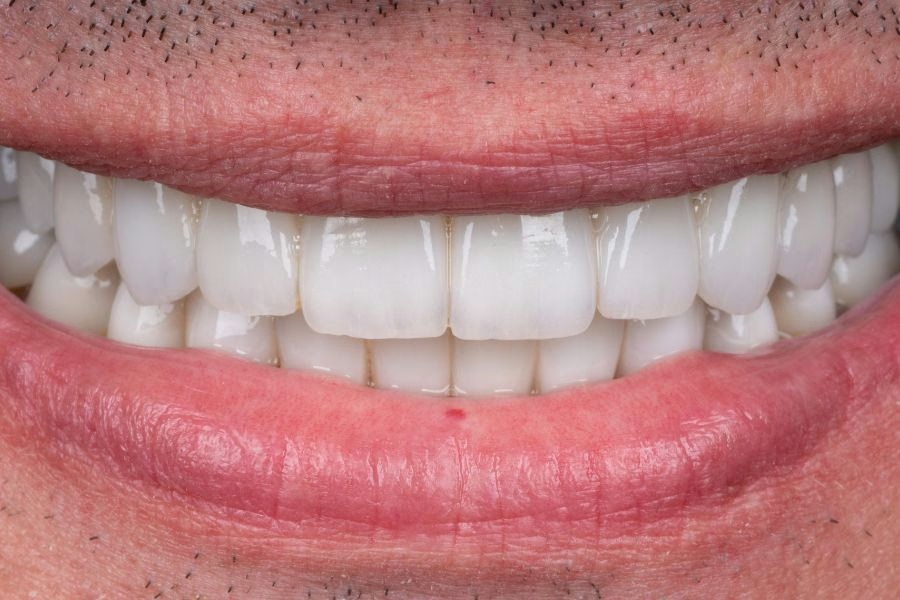

Dental physiotherapy deals with exactly this area: the temporomandibular joints, the chewing muscles and tension in the head and neck. At Flow Dental Studio we provide it together with bite diagnostics, so the results of the examination feed straight into decisions about further treatment. You do not have to go back and forth between separate places or repeat your medical history from scratch every time.
Below you will find a description of the symptoms, causes, what a visit involves and prices. If you recognise any of the signs described, book a consultation, because the treatment plan is only drawn up after the examination.
Symptoms that bring patients to a dental physiotherapist in Gdynia
- You wake up with a headache in your temples or a stiff jaw.
- Your partner says you grind your teeth at night.
- You hear a click or a jump when you open your mouth wide.
- After a day at the computer your neck and shoulders are tense, and in the evening the area around your ear hurts.
- You have ringing in your ear, even though an ENT specialist found no cause.
- You catch yourself clenching your teeth during the day, especially under stress.
- The edges of your teeth are worn, or you notice that the lower part of your face is becoming wider.
If you recognise two or more of these signs, an examination of the masticatory system will show where they come from.
Dental physiotherapy at Flow Dental Studio: key facts
Dental physiotherapy deals with dysfunctions of the temporomandibular joints, the chewing muscles and the tissues of the head and neck.
The most common reasons for a visit are jaw pain, clicking when opening the mouth, tension headaches, tinnitus and bruxism.
Overloading of the masticatory system is usually caused by stress, malocclusion, missing teeth, parafunctional habits and injuries.
Therapy combines manual techniques inside and outside the mouth with kinesiotherapy, that is, exercises the patient does themselves.
At Flow Dental Studio physiotherapy is carried out together with bite diagnostics, including recording jaw movements with the ZEBRIS digital axiograph.
You do not need a referral for the visit, and the treatment plan is drawn up after the examination, not before it.
What does dental physiotherapy in Gdynia involve?
Dental physiotherapy is the branch of physiotherapy devoted to the masticatory system. It covers the diagnosis and treatment of dysfunctions of the temporomandibular joints, the chewing muscles and the structures of the face, head and neck. The temporomandibular joint connects the lower jaw to the temporal bone of the skull and works with every swallow, every word and every bite of food. Under such a load, even a small disturbance in its mechanics produces symptoms felt around the clock.
The aim of therapy is to restore normal jaw function, reduce pain and improve everyday comfort. Physiotherapy can be used either as a treatment in its own right or as a stage preparing for prosthetic and orthodontic treatment. The approach rests on two pillars. The first is the therapist’s work on the patient’s tissues; the second is self-therapy, meaning exercises and changing habits at home.
What makes this field unique is that it combines two perspectives. Physiotherapy brings knowledge of biomechanics and how muscles work, and dentistry brings knowledge of occlusion, that is, how the teeth meet. Only by putting the two together can a muscle problem be told apart from a joint problem and a bite problem.
Dental rehabilitation, osteopathy and massage – how do they differ?
Dental rehabilitation is sometimes confused with treatments that have a different aim and a different scope. The difference lies not in the touch itself, but in what comes before it and what follows.
A relaxing facial massage lowers muscle tension for a short while, but it does not answer the question of where that tension came from.
Osteopathy looks at the body as a whole and uses its own diagnostic model rather than a functional examination of the masticatory system.
Dental rehabilitation starts with an examination of specific structures and ends with a plan that addresses the cause of the symptom.
In practice, this means that the relief after a massage usually wears off within a few days. After therapy aimed at the cause, the changes last longer. The condition, however, is a correct diagnosis, because the same complaint may originate in the joint, in a muscle or in an abnormal contact between the teeth.
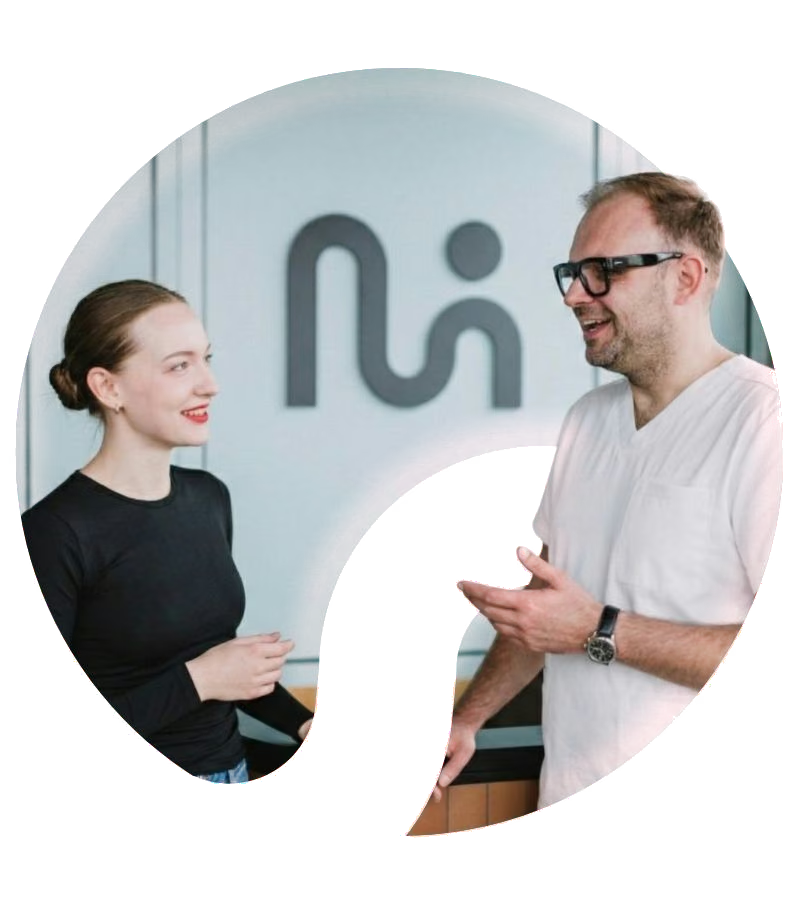
A holistic approach to dental treatment at Flow Dental Studio in Gdynia
In practice, a holistic approach means that we assess not a single tooth but how the whole masticatory system moves. Body posture, head position, neck tension and the way the teeth meet when you bite together form a single mechanism. Jaw pain is often the last link in this chain, not its beginning.
At Flow Dental Studio physiotherapy is part of a broader dental treatment plan, not a separate service taken out of context. Diagnosis of bite disorders is based on recording the jaw relationships and the rotation axis of the lower jaw with the ZEBRIS digital axiograph. The data from this examination then go into prosthetic planning, so that the restoration is made in line with how your jaw actually functions, not just with aesthetics.
An individual approach is a necessity here, not a slogan. Two patients with an identical symptom may need completely different treatment if in one the source is muscle overload and in the other a displaced articular disc.
Why we provide physiotherapy in Gdynia together with bite diagnostics
The results of each of these examinations go into a single plan. If it turns out that the symptoms stem from your bite, the decision about a splint, clear aligner orthodontics or restorative work is made by the dentist in charge of your treatment – the same one who knows the results of the physiotherapy examination.
Who carries out the therapy? Specialists in masticatory system dysfunction in Gdynia
Therapy around the face requires work on small and sensitive structures, often inside the mouth. It is carried out by a physiotherapist with dental training, in cooperation with the dentist responsible for restorative, prosthetic or orthodontic treatment. This arrangement makes it possible to combine work on the soft tissues with decisions about the bite.
The dental physiotherapist’s skills
A dental physiotherapist’s work goes beyond the treatment session itself. It covers assessment, planning and guiding the patient through the whole process, as well as giving them the tools to work on their own between visits.
- taking a history of symptoms, past injuries and previous treatment,
- a functional examination of the masticatory system, including an assessment of posture and cervical spine mobility,
- palpation of the muscles and joints inside and outside the mouth,
- manual therapy adapted to the patient’s pain threshold,
- choosing exercises and teaching self-therapy,
- education on habits, ergonomics and preventing recurrence.
Each of these elements affects the outcome. Skipping the posture assessment or the education stage means that the work done during the visit is quickly undone by everyday strain.
When should you see a dental physiotherapist in Gdynia?
Temporomandibular joint disorders can be misleading, because the symptoms appear in places far from the joint. Patients first go to an ENT specialist or a neurologist, and only after several fruitless consultations do they look for help elsewhere. The signs below justify a visit to a physiotherapist.
Temporomandibular joint pain and clicking
Pain around the ear that gets worse when eating, yawning and talking is the most typical picture of the condition. Temporomandibular joint pain is then sometimes mistaken for an ear infection. Clicking when opening the mouth usually indicates that the articular disc is not working properly. Grating and crunching sounds, known as crepitus, may accompany degenerative changes.
Good to know: sounds in the temporomandibular joint, even if completely painless, indicate disturbed mechanics. A consultation at this stage is simpler than once pain and restricted movement have joined in.
Tension headaches, migraines and tinnitus
Excessive tension in the chewing and neck muscles radiates to neighbouring areas. Tension headaches in the temples, forehead and back of the head are sometimes the result of overloaded masseter muscles rather than a disease of the head itself. A similar mechanism explains tinnitus, high-pitched ringing and a blocked-ear sensation with no identifiable ENT cause.
In some patients these symptoms persist for years and are treated only symptomatically. An assessment of the masticatory system is then often the missing piece of the puzzle.
Bruxism: teeth clenching and grinding
Bruxism is unconscious clenching and grinding of the teeth, most often at night. On waking there is stiffness around the jaw, and over time worn tooth surfaces and enlarged masseter muscles that change the facial features become visible. In adults this is sometimes the first symptom noticed.
Manual therapy reduces tension in overloaded muscles, and exercises teach you to recognise the moment when clenching occurs. Night-time grinding cannot be controlled consciously, so treatment focuses on reducing tension. Physiotherapy complements splint therapy well, because a splint protects the teeth but does not on its own change the way the muscles work.
Restricted jaw movement and difficulty opening the mouth
Changes in the range of jaw movement are a sign that should not be put off. They point to advanced disorders of joint mechanics.
- difficulty opening the mouth wide when eating and yawning,
- a feeling that the jaw locks in the open or closed position,
- jaw deviation, meaning the jaw moves along an S- or C-shaped path instead of straight down,
- a painful jump when opening or closing the mouth.
Symptoms of this kind rarely go away on their own. The longer the joint works along an abnormal path, the greater the risk that the disorder becomes established and the longer the subsequent therapy.
Sensitivity around the necks of the teeth
Chronic occlusal overload is sometimes linked to non-carious lesions around the necks of the teeth and to sensitivity to cold. The lesion itself is treated by a dentist, but unless the overload is reduced the problem comes back. That is why assessing function matters here as much as treating the tooth itself.
What overloads the temporomandibular joints and chewing muscles?
Dysfunction rarely has a single cause. Usually several factors overlap and strain the system for months until the limit of what it can cope with is exceeded. Identifying these factors determines whether the results of therapy will last.
Stress and excessive tension in the chewing muscles
Chronic stress raises resting muscle tension, especially in the masseters, the neck and the shoulder girdle. This creates excessive tension in the chewing muscles, which is transferred to the joints and keeps the pain going. Clenching your teeth during the day can go completely unnoticed, yet it still loads the system for many hours.
Malocclusion and missing teeth
Malocclusion and missing teeth disturb the distribution of forces during chewing. The muscles compensate for abnormal tooth contact by working harder and asymmetrically, which leads to fatigue and overloading of the joints. Untreated tension disorders can in turn worsen existing bite problems, so the mechanism works both ways.
Parafunctional habits and mechanical injuries
Repeated everyday habits load the joints just as effectively as a single injury. Four come up most often.
- biting your nails, cuticles and pens,
- constantly chewing gum,
- resting your chin on your hand,
- sleeping on your front with your head turned to the side.
Then there are injuries: a blow to the face, a road traffic accident, and also keeping the mouth open wide for a long time during a procedure. After extensive surgical procedures, when there is swelling and limited mouth opening, physiotherapy can be part of returning to normal function.
What does a visit in Gdynia look like? Your first visit step by step
The process is planned and predictable, and at every stage you know what is happening. Therapy is not about surprising the body with a stimulus, but about controlled work with the tissues. Below is the process from diagnosis to the exercises you do on your own.
History and functional examination
The first visit is devoted to diagnosis. Without it, therapy would only be working on the symptom. The functional examination includes an assessment of the range and path of jaw movement. It also involves palpation of the muscles of the face, temples, neck and floor of the mouth, and an assessment of posture and head position. Where justified, it is complemented by an objective recording of jaw movements with the ZEBRIS digital axiograph.
The outcome of the first visit is a description of the problem and a treatment plan. You find out which structures are not working properly and what this means for further dental treatment.
Diagnostics take place in one place, together with CBCT, intraoral scanning and an occlusal assessment. You do not need to book tests separately or carry results between places, because they go straight into the treatment plan. This shortens the path from the first examination to the first treatment session.
Intraoral and extraoral manual therapy
Manual therapy is the core of the treatment. External work covers the muscles of the face, temples, neck and shoulder girdle. Intraoral work is carried out wearing gloves, directly on the chewing muscles, and uses deep tissue techniques, trigger point therapy and joint mobilisation. These techniques relieve pain and lower muscle tension.
Working on a very tense muscle can cause temporary discomfort. However, it should not be very painful – the intensity is adjusted to your pain threshold and modified during the session.
Kinesiotherapy and exercises between visits
Kinesiotherapy is the part of therapy carried out by the patient. The set of exercises is chosen individually and usually includes controlled mouth opening with the tongue resting against the palate, as well as gentle self-massage of the masseter and temporal muscles. The exercises take a few minutes and are done every day.
Without this part, the effect of therapy is short-lived. The work done during the visit changes the state of the tissues, but it is your everyday habits that decide whether the change lasts.
What you will hear at your first visit in Gdynia – and what you won’t
- which structures are not working properly and why this gives you these particular symptoms,
- whether the source lies in the muscles, the joint or the bite,
- how many visits we expect and what will happen at each one,
- how much it will cost, before you decide on therapy,
- which exercises you will do at home and why,
- whether a splint, orthodontics or other treatment is needed and, if so, in what order.
- that you have come too late,
- that “it’s just stress” without checking what exactly is overloaded,
- a diagnosis made without an examination,
- a promise that one visit will solve a problem that has been building up for years,
- a price given over the phone without knowing your case.
Dental physiotherapy before orthodontic treatment in Gdynia
Preparing the muscles and joints before orthodontic treatment begins sets the right starting conditions. The teeth are then moved within a system in which tension is balanced and the joint works along a normal path. The same applies to prosthetic treatment, where the bite is rebuilt from scratch.
Physiotherapy is sometimes recommended before orthodontic treatment when there is marked muscle tension, restricted jaw movement or joint symptoms. At Flow Dental Studio orthodontic treatment is carried out exclusively with clear aligners, and the treatment plan is drawn up after an assessment of the bite. Working on the tissues beforehand reduces the risk of joint pain appearing while you wear the aligners.
Splint therapy and cooperation between the physiotherapist and the dentist
Here, cooperation between the physiotherapist and the dentist is a condition of sensible treatment, not an add-on. The physiotherapist works with the muscles and joints, the dentist is responsible for the bite and the condition of the teeth, and decisions on one side affect the other. Looking after the patient together makes it possible to set the right order of steps.
Splints and deprogrammers are also used in the treatment of bite disorders. A deprogrammer switches off the habitual bite pattern, while a bio-orthotic appliance (MAGO splint) guides the lower jaw into a set position. Manual therapy and splint therapy complement each other: the splint changes the conditions in which the joint works, and physiotherapy prepares the tissues for it.
What results can you expect from therapy in Gdynia?
Results appear gradually and depend on how long the symptoms have lasted. Some patients feel less pain after the very first session, while others need several visits. The number of sessions is set after the examination and may be adjusted during treatment.
less pain in the jaw, head, face and neck,
a wider and more symmetrical mouth opening,
clicking and jumping disappearing or becoming quieter,
easier chewing, yawning and talking,
lower muscle tension in the head, neck and shoulders,
better conditions for further prosthetic or orthodontic treatment.
How long these changes last depends on two things: removing the cause of the overload and doing the exercises regularly. Going back to old habits usually means the symptoms come back, which is why education is as important as the treatment itself.
What to do before your first visit in Gdynia
Time of day, activity (eating, talking, mornings), side. This information shortens the history-taking and makes diagnosis easier.
X-rays, CBCT scans, reports from previous consultations, if you have them. They are not required for the visit.
Do you chew gum, rest your chin on your hand, clench your teeth while working? You do not need to change them before the visit – it is enough to notice them.
You do not need to know whether it is the joint, a muscle or your bite. That is what the examination is for.
Book a visit at Flow Dental Studio in Gdynia
If you have jaw pain, hear clicking when you open your mouth or wake up with a stiff jaw, an assessment of the masticatory system will tell you where these symptoms come from. At Flow Dental Studio dental physiotherapy is carried out together with bite diagnostics, so the results of the examination feed straight into the treatment plan.
You can book a visit by phone or through the contact form. The sooner you come for an examination, the simpler the treatment tends to be and the fewer structures have time to become overloaded.
Tell us what symptoms you have, and we will call you back to arrange a consultation in Gdynia.
Flow Dental Studio
ul. Arkadiusza Rybickiego 2B/U2, 81-340 Gdynia
+48 786 420 004
info@flowdentalstudio.pl
Monday – Friday, 9:00 – 20:00