

Dental implants Gdynia - a fixed tooth where the gap was
A missing tooth changes more than the look of your smile: it makes biting harder, lets the neighbouring teeth shift and, over time, leads to bone loss. An implant replaces the tooth root, and the crown on it looks and works like your own tooth. We plan every treatment digitally before the procedure begins.
4.9/5 43 reviews on Google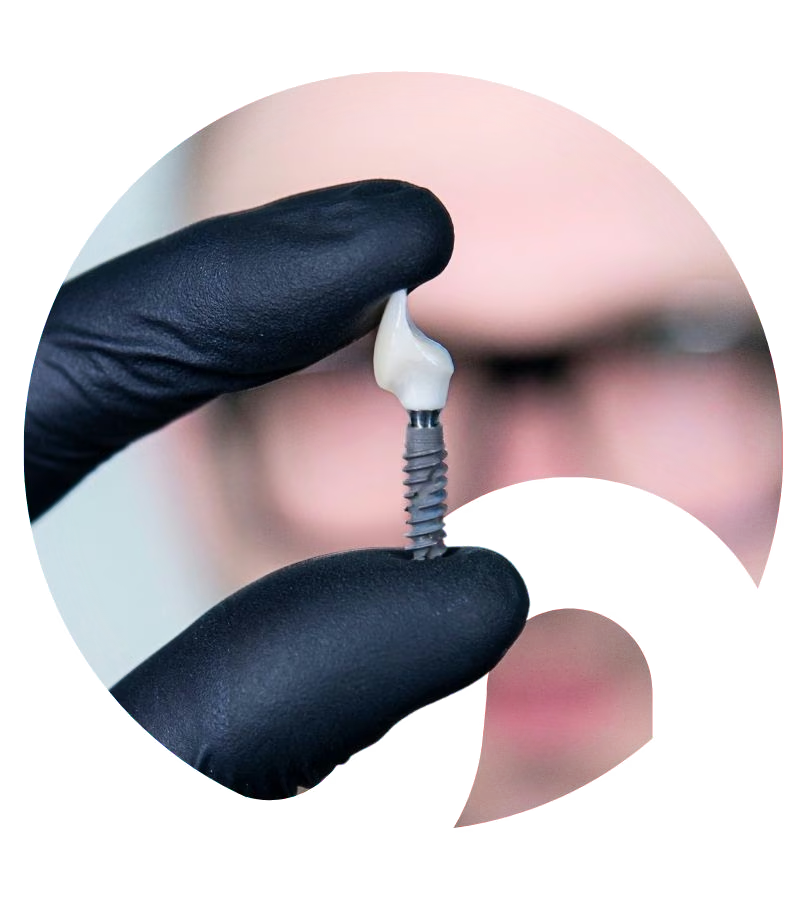
-
CT scanning on site
-
Planning in coDiagnostiX
-
Implant from 3400 PLN
How do you know an implant is right for you?
I'm missing a tooth, and when I eat I automatically chew on the other side.
I don't smile widely because the gap shows.
I've been offered a bridge, but I don't want the healthy teeth next to it ground down.
My denture moves and I'm afraid it will fall out in front of people.
I have a tooth that needs to come out and I don't want to be left with a gap.
I have been told I don’t have enough bone for an implant.
If you recognise yourself in any of these statements, an implant may be a good way forward for you. Whether it will work in your case is something we decide at a consultation with a CT scan.
How can we help?
The six concerns patients most often bring to an implant consultation, and what we do about each of them.
“I'm afraid the procedure will hurt.”
If you are worried about pain: the procedure is carried out under anaesthesia, and thanks to digital planning and a surgical guide, the disruption to the tissues is kept as small as possible. After the procedure you receive instructions for the first days of healing.
“I don't have enough bone.”
If you have been told you don't have enough bone: we assess its amount and quality on a CT scan taken on site, and if there is too little, we rebuild it with a bone graft, biomaterial or a membrane.
“I don't know if the implant will take.”
If you are worried the implant will not fuse with the bone: failures are rare with proper patient assessment, 3D diagnostics and good hygiene. We base our assessment on a CT scan and an evaluation of your health, and we discuss the risks with you before the procedure.
“I don't want to go without teeth for several months.”
If you don't want to be left with a gap: when a whole arch is being restored and the clinical conditions allow, you receive a fixed temporary restoration on the same day. For smaller gaps, the dentist will discuss how to protect the gap while it heals.
“I'm afraid the cost will go up during treatment.”
If the price is holding you back: you know the price of the surgical stage in advance, from 3400 PLN depending on the type of implant, and after diagnostics you receive a full cost estimate including the abutment, the crown and any bone rebuilding. You can spread the cost of treatment over instalments.
“Can I have an implant if I have diabetes or osteoporosis?”
If you have a chronic condition: well-controlled diabetes or treated osteoporosis do not usually rule out implants, but they need to be assessed, sometimes in consultation with your doctor. We make the decision at the consultation.
Dental implants in Gdynia: treatment at a glance
You will find a full description of each stage further down the page. Here is the shortest version of what to expect.
What is a dental implant and what does a new tooth consist of?
An implant is the permanent base for your new tooth - a titanium or zirconia “root” placed in the bone, onto which we fit a crown that looks and works like a natural tooth.
An implant can replace a single tooth, several teeth or a whole arch. Treatment usually takes several months, because the implant has to fuse with the bone before it can take a crown.
A titanium or zirconia screw in the bone that replaces the tooth root and fuses with the bone tissue.
A component attached to the implant after healing that protrudes above the gum - the support for the crown.
The visible part of the tooth, made of porcelain or zirconia, which restores its shape, colour and function.
Who will treat me?
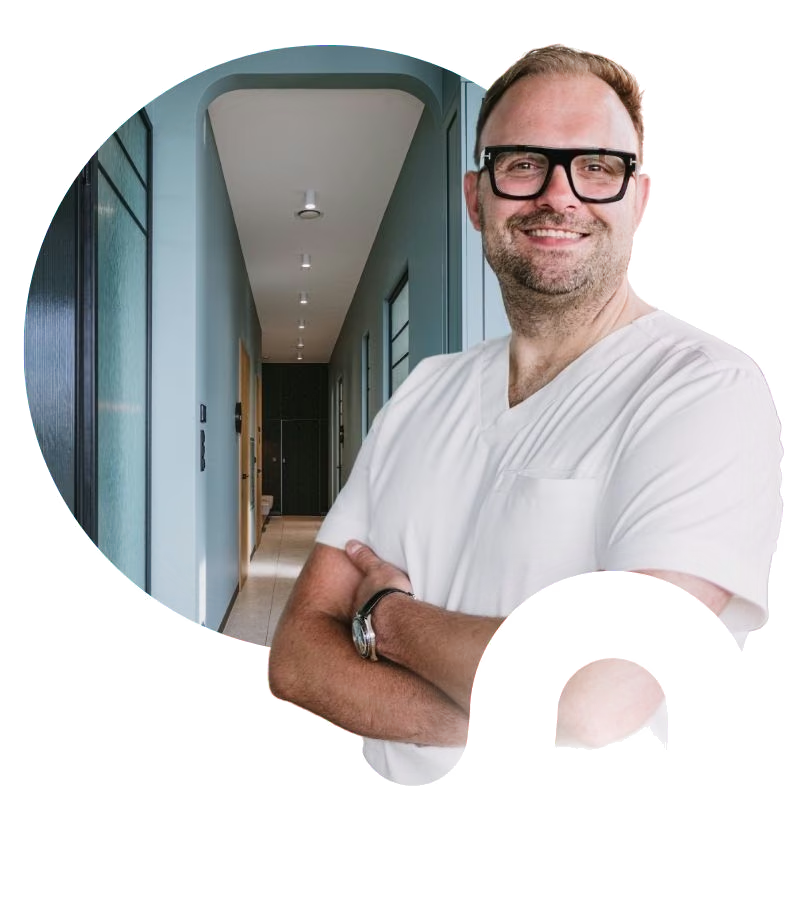
Implant treatment at Flow Dental Studio is carried out by Adrian Kiepuszewski - from the consultation and CT scan, through the procedure, to fitting the crown. He has more than 16 years of experience in implantology and oral surgery, and has completed a Harvard School of Dental Medicine programme in implant and periodontal treatment.
Because he also practises prosthodontics, orthodontics and endodontics, he plans the implant together with the crown from the outset, rather than as a separate procedure.
- NewTom Giano HR CT scanner
- Planning in coDiagnostiX
- TRIOS 5 scanner
How much does a dental implant cost in Gdynia?
The price of the surgical stage depends on the type of implant. The dentist will choose the one that suits you after a CT scan.
-
Basic A standard titanium implant. A solution for patients with good bone conditions. Book a consultation3400 PLN
-
Standard A higher-grade titanium implant. A good balance of quality, stability and price. Book a consultation3900 PLN
-
Zirconia A zirconia implant made to order. A light-coloured material that does not show through the gum. Book a consultation5000 PLN
-
Implant consultation200 PLN
-
Screw-retained implant crown on a custom or hybrid abutment4500 PLN
-
Bone grafting (regeneration)from 2500 PLN
You can spread the cost of treatment in instalments.
See the full price list“I had the pleasure of being treated by Dr Kiepuszewski at Flow Dental Studio, and I can honestly say he is an exceptional dentist.”
Patient reviews on Google

Very professional and friendly. A visit to the dentist can be a pleasant experience after all. The aligners are comfortable and hygienic, and week by week I can see my teeth straightening. I recommend it.
Translated from Polish
I had the pleasure of being treated by Dr Kiepuszewski at Flow Dental Studio, and I can honestly say he is an exceptional dentist. Wisdom tooth extraction, which so many patients dread, took place in a comfortable atmosphere. Dr Adrian is not only extremely competent but also has a wonderful approach to patients, full of understanding and care. I also decided on aligner treatment. The doctor's precise work and professionalism mean the visits run smoothly and in a pleasant atmosphere. My smile looks better and better, and I know it was the best decision. I recommend him to anyone who dreams of straight teeth without pain or discomfort! The Flow Dental Studio practice itself also deserves a special mention. Modern equipment, a beautiful interior, a pleasant atmosphere and kind, courteous staff make patients feel looked after, and the visit becomes a much more pleasant experience. It is a place that cares not only about healthy teeth but also about the patient's wellbeing.
Translated from Polish
Flow Dental Studio is a place where professionalism goes hand in hand with empathy and care for the patient. I had professional teeth cleaning and fillings there, and I am very impressed by the precision and gentleness of the treatment. Dr Julia and Daria explain everything thoroughly, and the atmosphere at the practice is calm and friendly. It is definitely a practice you can trust completely, which is why I will be back whenever the opportunity arises :)
Translated from Polish
Beautiful practice, professional staff, and the doctor is the GOAT. I didn't even notice when it was over – the nasty wisdom tooth is gone. Highly recommended.
Translated from Polish
It is rare to find places where professionalism goes hand in hand with genuine empathy — but Flow Dental Studio is exactly that kind of place. I had the pleasure (yes, it really can be called that!) of being in Dr Adrian's care for a wisdom tooth extraction I had been dreading for a long time because of severe hypersensitivity. What sets Dr Adrian apart is not only his exceptional skill and precision, but above all his extraordinary respect for the patient's boundaries and feelings. Every gesture and every word – full of calm, understanding and attentiveness – made me feel cared for at every stage of the procedure. A procedure that had filled me with fear turned out to be an almost... soothing experience. No pain, no tension, and great attention to my mental and physical comfort. This is not just dentistry at the highest level — it is the art of creating a safe space in a place usually associated with stress. From the bottom of my heart, thank you to Dr Adrian and the whole Flow Dental Studio team for making it possible to come to you anxious — and leave grateful and smiling.
Translated from Polish
I recommend Dr Adrian. A very professional approach to patients.
Translated from PolishDental implants in Gdynia: patient questions
Does the procedure hurt?
How long does healing take?
How long do implants last?
What complications are possible?
Can I have implants if I don't have enough bone?
Can an implant fall out?
Can I have implants if I have osteoporosis or a general health condition?
What is an implant?
An implant is the permanent base for your new tooth - a titanium or zirconia “root” placed in the bone, onto which we fit a crown that looks and works like a natural tooth. At Flow we plan every implant digitally, so you get a solution that looks natural and serves you for years.
When is an implant worth considering?
When you want to restore the function and appearance of your smile - for a single missing tooth, several missing teeth, a restoration in the smile zone, or as a stable base for a bridge or denture. An implant combines durability, natural aesthetics and comfort. At Flow we also take on complex cases, including those that require bone rebuilding.
Stages of implant treatment in Gdynia
Consultation and diagnostics
During the appointment, Adrian Kiepuszewski will carefully assess your smile using photographic analysis, a TRIOS intraoral scan, a NewTom Giano HR CT scan and a ZEBRIS bite function examination. This means your treatment is planned comprehensively - taking into account not only the correct position of the implant, but also comfort, function and a natural final result.
Digital planning
Using coDiagnostiX (implant planning software) and Exocad (prosthetic software), we create a digital simulation of the treatment and a design of your future prosthetic restoration. We first plan the intended appearance and function of your smile, and then choose the optimal positions and axes for the implants. Custom-made surgical guides allow us to transfer this plan precisely to the mouth during the procedure, making it safer and more predictable.
Precise and comfortable implant placement
We carry out the procedure in sterile conditions and a calm, comfortable atmosphere. We choose the method that suits your situation - guided surgery with a custom guide or a freehand technique. In every case we aim for minimal disruption to the tissues, high precision and the gentlest possible healing.
Bone rebuilding - a stable base for the implant
If the amount or quality of bone turns out to be insufficient, we will rebuild it using an individually chosen method, such as a bone graft, a bone block, biomaterial or a membrane. This creates stable conditions for implant placement and makes the results more predictable and longer-lasting - even in more demanding anatomical situations.
Fixed restoration of a whole arch - even in one day
If you have no teeth at all, or your teeth need to be extracted, we can restore the whole dental arch on implants. If the clinical conditions allow, you receive a fixed temporary restoration on the same day. This means you leave our Studio without a period of having no teeth - with a natural-looking smile, greater comfort and more confidence in everyday situations.
Final prosthetic stage - a natural, long-lasting result
At the final stage we prepare custom-fitted abutments and crowns. We use CAD/CAM technology, that is, computer-aided design and precise manufacturing of prosthetic restorations based on a digital design created in Exocad. As a result, the crown fits closely, does not rub and leaves no gaps where plaque can collect. A smaller gap means a lower risk of inflammation and a longer life for the restoration.
Check-ups and retention
Regular check-ups, gentle Airflow cleaning and an individual care plan help keep your implants healthy and the aesthetic result in place for many years. With systematic care we can respond early to any changes and look after your comfort and peace of mind.
How do we keep implant treatment safe?
- Materials: implants and abutments from recognised brands, certified cements and ceramics.
- Full diagnostics: CT scanning, 3D scans and bite function analysis to reduce surprises during the procedure.
- Experience: Adrian Kiepuszewski, who has completed a Harvard School of Dental Medicine programme and implant training, a team of specialists and ongoing training.
- Surgical guides and a digital workflow: coDiagnostiX and CAD/CAM reduce risk and make the result more predictable.
- Aseptic protocols and aftercare reduce the risk of complications.
Care after the procedure. Gentle hygiene in the first few days, prescribed mouth rinses and avoiding putting pressure on the treated area. Once healed - regular Airflow cleaning, bite checks and monitoring of the periodontal tissues. With an individual care programme, the result lasts for years.
Dental implants in Gdynia - what to know before treatment
What is a dental implant and what does it offer when a tooth is missing?
A dental implant is an artificial tooth root made of a biocompatible material, most often titanium or zirconium oxide, which is surgically placed in the bone of the upper or lower jaw. It acts as an abutment for a prosthetic restoration - a crown, bridge or denture. Thanks to osseointegration, the permanent fusion with bone tissue, the implant takes over the function of the tooth root.
When a single tooth is missing, an implant is often a good solution for many people because, unlike a bridge, it does not require grinding down the healthy teeth next to the gap. An implant loads and stimulates the bone, limiting the bone loss that follows tooth extraction - something removable dentures do not prevent. Titanium is compatible with the human body, which is why implants restore chewing strength and comfort close to that of natural teeth.
Which missing teeth can be replaced with implants?
Implants can replace virtually any missing teeth - from a single tooth, through gaps at the back of the mouth, to complete toothlessness. A single implant replaces one tooth, several implants can support a bridge, and when no teeth remain the whole arch rests on 4 or 6 implants. Teeth are lost for various reasons: decay, injury, gum disease or extraction.
The sooner a gap is filled, the better, because bone that carries no load gradually shrinks. An implant stops this process, protects the neighbouring teeth and prevents the remaining teeth from drifting towards the gap.
Types of implants - how to choose dental implants
How to choose dental implants depends on the anatomical conditions, the patient's individual needs and aesthetic expectations. Two main materials are used in implantology: titanium and zirconium oxide (ceramic implants). Both are biocompatible, and the dentist chooses the right solution after an individual assessment at the consultation.
Titanium implants have been used in dentistry for decades and have a documented, predictable integration with bone. Medical-grade titanium fuses well with bone tissue and withstands strong chewing forces. The wide range of systems available means the implant can be matched to different clinical conditions. A limitation can be the metallic colour, which may show through slightly where the gum is very thin.
Who is a candidate for an implant? Indications and contraindications
Implant treatment is now possible in the vast majority of cases of missing teeth. A candidate is someone in good general health whose bones have stopped growing and who looks after their oral hygiene. A sufficient amount of bone is needed to anchor the implant stably, and this is assessed on a CT scan.
There are, however, contraindications. Absolute contraindications include active cancer during chemotherapy and severe, untreated immune disorders. More common are relative, temporary contraindications that can be resolved before implant treatment: poorly controlled diabetes, untreated gum disease, some heart conditions, and smoking, which impairs healing. The dentist decides whether you qualify based on an individual assessment and your general health.
What conditions need to be met for the procedure to succeed?
The success of treatment depends on several conditions. The most important are:
- an adequate amount and quality of bone at the implant site,
- a healthy mouth, with no gum inflammation, gum disease or untreated tooth decay,
- careful oral hygiene maintained after the procedure,
- working with the dentist and following their instructions at every stage.
Success is a joint effort between the dentist and a committed patient - the patient's role is just as important as precision during the procedure.
Dental implants vs a bridge and a denture - what are the key differences?
Dental implants differ from a bridge and a removable denture mainly in that they are a stand-alone solution and put no load on the neighbouring teeth. A bridge requires the healthy teeth next to the gap to be ground down, while a denture rests on the gum and can be less stable.
An implant is the only one of these solutions that loads the bone and limits bone loss, whereas under a bridge or denture the bone continues to shrink. In terms of comfort and the look of your smile, an implant is the closest thing to your own tooth, which is why it is often chosen instead of a restoration that relies on healthy neighbouring teeth.
How much do dental implants cost in Gdynia? What makes up the cost?
The price of an implant is not the same as the total cost of treatment - the final amount is made up of several separate procedures. We present a detailed, individual cost estimate after diagnostics. The cost includes:
- the consultation and radiological diagnostics (CT scan),
- the surgical stage, that is, the implant itself, depending on the chosen system,
- the abutment that connects the implant to the crown,
- the prosthetic crown on the implant, for example an all-ceramic crown,
- any bone rebuilding or sinus lift, if needed.
Guided bone regeneration - when is bone rebuilding needed?
Guided bone regeneration (bone grafting) rebuilds the bone when there is too little of your own tissue to anchor an implant stably. The defect is filled with bone substitute material under a protective membrane, which creates the conditions for your own bone to regenerate. It is an additional procedure that extends treatment by the healing period, and its price depends on the size of the defect and the amount of material. The need for bone grafting is assessed on a CT scan during the consultation.
Dental implants Gdynia - why Flow Dental Studio?
Implant treatment at Flow Dental Studio in Gdynia is provided by a team led by implantologist Adrian Kiepuszewski, who has more than 16 years of experience in implantology and oral surgery. Thorough diagnostics and proven implant systems make treatment safe and predictable.
We work with our own digital equipment - a NewTom Giano HR CT scanner, a TRIOS 5 scanner and coDiagnostiX software - and provide comprehensive care with a personal patient coordinator.
Book an implant consultation in Gdynia
At the consultation we will take a CT scan and assess your bone and bite, and you will leave knowing which implant is right for you, how long treatment will take and how much it will cost.
Read before you decide
What does an implant really cost? Placement from 3400 PLN, crown on an implant 4500 PLN. We break down the price before you decide.
Read more
Cheap implants and long-term cost: how implant quality, 3D diagnostics and planning affect how long treatment lasts and the risk of costly corrections.
Read more
Diabetes, Hashimoto’s, high blood pressure, osteoporosis and implants: which contraindications are absolute, which are relative and how suitability is assessed.
Read moreStart your journey to a restoration that combines aesthetics with lasting function. We will call you back within 24 hours and arrange an implant consultation.
Flow Dental Studio
ul. Arkadiusza Rybickiego 2B/U2, 81-340 Gdynia
+48 786 420 004
info@flowdentalstudio.pl
Monday – Friday, 9:00 – 20:00