
Dental bonding in Gdynia – cosmetic composite restoration
A chipped edge on a front tooth or a gap that bothers you in every photo does not require filing your teeth down. All it takes is adding material where it is missing and shaping it in the chair. That is what bonding is about: we add rather than remove.
See a design of your smile before you decide
4.9/5 43 reviews on Google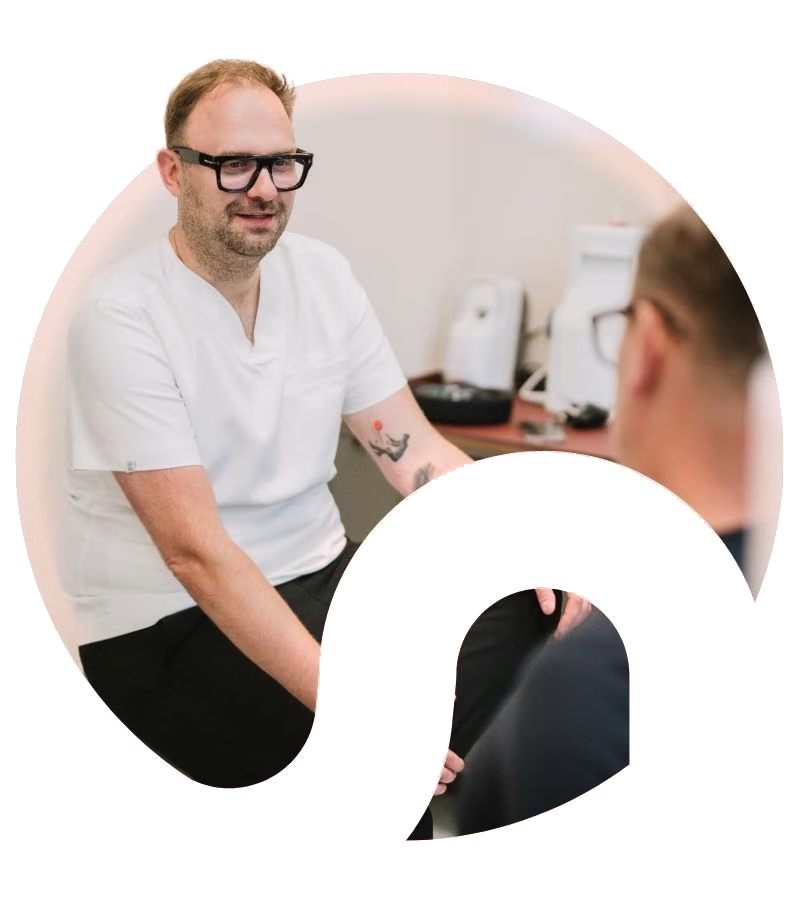
-
shaped under a ZEISS Extaro 300 microscope
-
3D diagnostics on site CBCT scanner and TRIOS 5 intraoral scanner
-
One dentist from consultation to result
How can you tell whether bonding is right for you?
The gap between my front teeth bothers me in every photo.
I have chipped the edge of a tooth and I keep running my tongue over it.
My teeth are too short and you can hardly see them when I smile.
One stain is still there, even though whitening did its job.
I want to improve my smile, but I will not have healthy teeth filed down.
If at least one of these sounds like you, bonding may be a good option. Whether it will work for your tooth is something we decide at the consultation, and below we answer the questions that most often hold people back.
How can we help?
The five concerns patients most often bring to a consultation, and what we do about each of them.
“I don’t know if bonding will be enough in my case.”
If you are not sure whether this is the right option for you, we settle it at the consultation: we assess the tooth, your bite and your expectations. And if a veneer or orthodontic treatment first would work better, we tell you so plainly before we start anything.
“I’ve heard that bonding turns yellow and falls off.”
If durability is your concern: the result usually lasts 3 to 10 years, and polishing at check-up visits keeps it looking good for longer. If it chips, we add a new layer of composite without replacing the whole restoration.
“I’m worried the added material will show.”
If a natural look matters to you, we choose the shade from a shade guide before your teeth dry out, apply the composite in layers of different translucency and shape it under a ZEISS Extaro 300 microscope. Finally, polishing gives a natural shine.
“I don’t want the price to go up once I’m in the chair.”
If price is holding you back, you receive a cost estimate after the consultation together with your smile design: with the number of teeth to restore and the full amount before you decide. You will also find a guide price range in the price list further down this page.
“I won’t let anyone file down healthy teeth.”
If you are worried about invasiveness: bonding works by adding material, and we prepare the enamel by etching it, not by grinding it down. In some cases the edge of the tooth needs minimal preparation, and we will tell you so honestly before treatment.
Dental bonding in Gdynia: the treatment at a glance
You will find a full description further down the page. Here is the shortest version of what to expect: for a single tooth, the whole procedure takes 30 to 60 minutes.
What would you like to improve? See whether bonding is the right option
If the teeth are properly aligned in the arch, we close it with composite in a single visit, keeping the proportions right.
Shade matched to the neighbouring teeth, rebuilt under a microscope. The most common reason for bonding.
First we assess your bite and chewing muscles. If you grind your teeth, you need a splint first; otherwise the composite will chip within a few months.
A thin layer of composite masks antibiotic staining, fluorosis and enamel hypoplasia.
Composite cannot withstand forces it is not designed for. Bonding only makes sense once the teeth have been straightened.
For an extensive smile makeover, ceramic lasts longer and does not absorb stains. Bonding is not strong enough here.
Who will treat me?
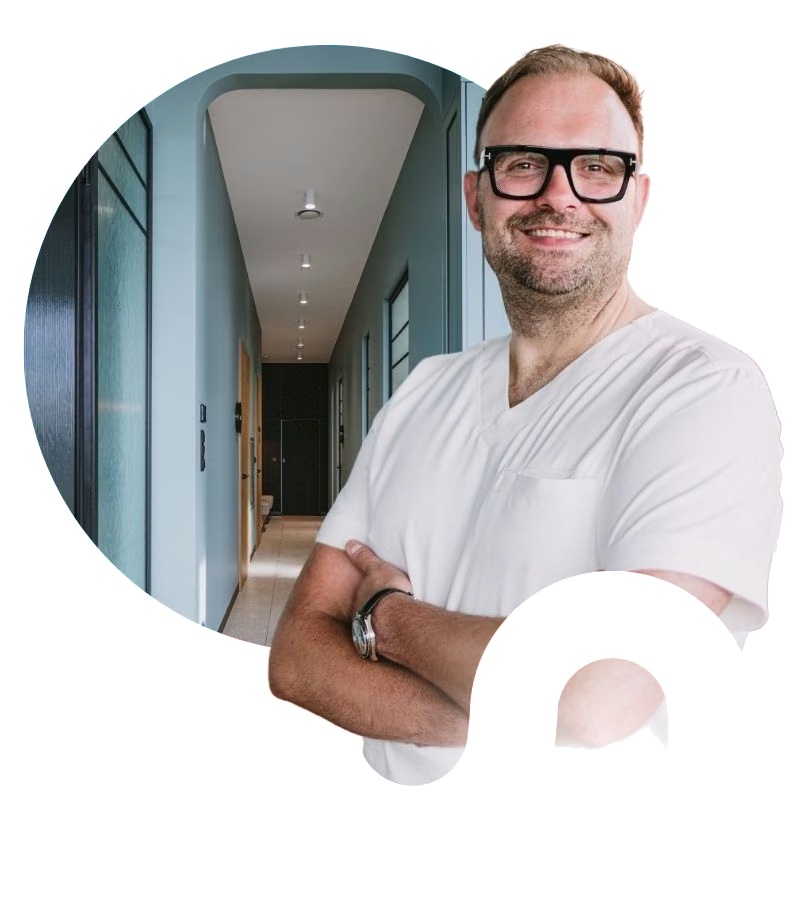
Treatment at Flow Dental Studio is led by Adrian Kiepuszewski, dentist, from the consultation and smile design through to the finished result. For aesthetic composite restorations, including bonding, he works with dentist Julia Mesjasz.
The result of bonding depends as much on the dentist's skill and eye for aesthetics as on the material, which is why the shape is modelled directly on the tooth under a ZEISS Extaro 300 microscope. You can read more about his experience on the About Dr Adrian Kiepuszewski page.
- Aesthetic composite restorations
- Smile design before treatment
- ZEISS Extaro 300 microscope
How much does dental bonding cost in Gdynia?
The price is set individually after a consultation, as it depends on the scope of work and the number of teeth being restored. Across the market, bonding typically costs from 700 to 1200 PLN per tooth. Bonding a single tooth usually starts at 700 PLN. Within that range, bonding four teeth costs around 3000 PLN, which gives you an idea of the order of magnitude before your visit.
For comparison, an all-ceramic veneer costs from 3000 PLN in the Flow Dental Studio price list. The prices given are for information only and do not constitute a commercial offer within the meaning of Article 66 § 1 of the Polish Civil Code; you will receive a cost estimate after your examination.
Three things affect how much bonding costs in your particular case.
The scope of work, that is whether the restoration involves one tooth or the whole front section.
The complexity, as rebuilding a tooth after an injury takes more work than closing a narrow gap.
Whether any treatment is needed beforehand, such as professional teeth cleaning at 450 PLN or in-office lamp whitening at 1500 PLN.
-
professional cleaning before treatment450 PLN
-
lamp whitening, if planned1500 PLN
-
for comparison: all-ceramic veneerfrom 3000 PLN
Cost estimate after the consultation, together with your smile design.
You can spread the cost of treatment in instalments.
See the full price list“I particularly appreciate Dr Adrian's prosthetic work – a beautifully natural result that is very hard to find.”
Patient reviews on Google

Very professional and friendly. A visit to the dentist can be a pleasant experience after all. The aligners are comfortable and hygienic, and week by week I can see my teeth straightening. I recommend it.
Translated from Polish
I had the pleasure of being treated by Dr Kiepuszewski at Flow Dental Studio, and I can honestly say he is an exceptional dentist. Wisdom tooth extraction, which so many patients dread, took place in a comfortable atmosphere. Dr Adrian is not only extremely competent but also has a wonderful approach to patients, full of understanding and care. I also decided on aligner treatment. The doctor's precise work and professionalism mean the visits run smoothly and in a pleasant atmosphere. My smile looks better and better, and I know it was the best decision. I recommend him to anyone who dreams of straight teeth without pain or discomfort! The Flow Dental Studio practice itself also deserves a special mention. Modern equipment, a beautiful interior, a pleasant atmosphere and kind, courteous staff make patients feel looked after, and the visit becomes a much more pleasant experience. It is a place that cares not only about healthy teeth but also about the patient's wellbeing.
Translated from Polish
Flow Dental Studio is a place where professionalism goes hand in hand with empathy and care for the patient. I had professional teeth cleaning and fillings there, and I am very impressed by the precision and gentleness of the treatment. Dr Julia and Daria explain everything thoroughly, and the atmosphere at the practice is calm and friendly. It is definitely a practice you can trust completely, which is why I will be back whenever the opportunity arises :)
Translated from Polish
Beautiful practice, professional staff, and the doctor is the GOAT. I didn't even notice when it was over – the nasty wisdom tooth is gone. Highly recommended.
Translated from Polish
It is rare to find places where professionalism goes hand in hand with genuine empathy — but Flow Dental Studio is exactly that kind of place. I had the pleasure (yes, it really can be called that!) of being in Dr Adrian's care for a wisdom tooth extraction I had been dreading for a long time because of severe hypersensitivity. What sets Dr Adrian apart is not only his exceptional skill and precision, but above all his extraordinary respect for the patient's boundaries and feelings. Every gesture and every word – full of calm, understanding and attentiveness – made me feel cared for at every stage of the procedure. A procedure that had filled me with fear turned out to be an almost... soothing experience. No pain, no tension, and great attention to my mental and physical comfort. This is not just dentistry at the highest level — it is the art of creating a safe space in a place usually associated with stress. From the bottom of my heart, thank you to Dr Adrian and the whole Flow Dental Studio team for making it possible to come to you anxious — and leave grateful and smiling.
Translated from Polish
I recommend Dr Adrian. A very professional approach to patients.
Translated from PolishDental bonding in Gdynia: patient questions
Does bonding hurt?
Can bonding be done on just one tooth?
Can bonding be whitened?
Does bonding look natural?
Do I need to change how I eat after bonding?
What should I do if the composite chips?
What exactly is bonding?
It is a restoration of the tooth with composite, a mouldable, enamel-coloured resin that we apply in thin layers directly onto the tooth and shape in place. We add material where tooth structure is missing or where we want to change the tooth's shape, length or colour.
The whole result is usually achieved in a single visit: for one tooth the procedure takes 30 to 60 minutes, and we match the shade so that the restoration blends in with the rest of your smile.
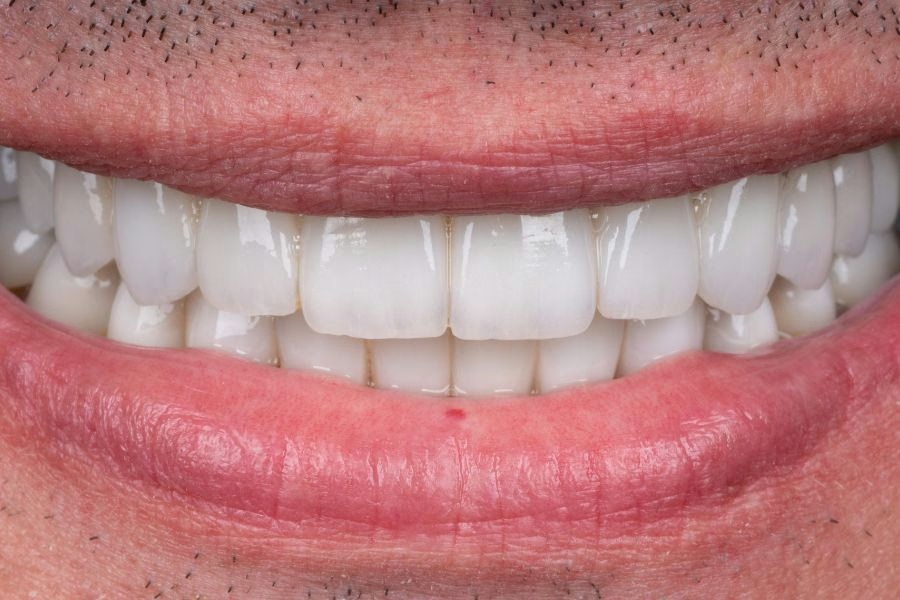
First you see the result, then you decide
The method does have its limits, and they need to be stated honestly. Composite is less resistant to staining than ceramic. How long it lasts depends largely on what the patient does after leaving the chair.
At Flow Dental Studio in Gdynia we use a combined approach. We restore back teeth with the flow injection technique, while front teeth are layered by hand under a ZEISS Extaro 300 microscope.
Dental bonding at Flow Dental Studio in Gdynia: key facts
Dental bonding is an aesthetic composite restoration carried out without grinding down healthy tooth tissue.
For a single tooth, the procedure usually takes 30 to 60 minutes and is completed in one visit.
Bonding is estimated to last 3 to 10 years, depending on oral hygiene and diet.
The procedure usually does not require anaesthesia, as it does not affect the dentine.
A healthy mouth is a prerequisite: no tooth decay and no gum inflammation.
Whitening is done before bonding, because composite does not lighten with whitening products.

What is dental bonding and how does the method work in Gdynia?
It is an aesthetic composite restoration in which composite resin is applied to the surface of the teeth to change their shape, length or colour. It is an additive method, meaning it works by adding material, so bonding does not require the teeth to be ground down to the extent that prosthetic work does.
The result comes from a combination of two things: the properties of composite resins and the work of the dentist, who models the material directly in the mouth. The result is a composite veneer made on the tooth itself rather than in a laboratory.
In practice, the outcome depends as much on the dentist's manual skill and experience as on the material. Composite alone does not deliver what a patient would call an excellent aesthetic result. That depends on layering, choosing the right translucency and finishing the surface, work that relies on the dentist's aesthetic sense.
Bonding in other fields versus dental bonding in Gdynia
The word bonding means joining, which is why it turns up in so many different fields. Search engines mix these meanings up, so it is worth separating them.
In dentistry the word has kept its original sense. In medicine, bonding refers to the chemical bonding of tissues, and in aesthetic dentistry it has become the name for a composite restoration based on adhesion to the enamel.
Indications: when is bonding used in Gdynia?
Bonding works well for small-scale corrections on healthy teeth. It is not meant to mask problems that need treatment, so the list of indications is fairly specific.
Closing a diastema and small gaps
By widening teeth with composite, we can close a gap between the front teeth or get rid of small spaces across the whole arch. In many cases this improves the shape of the teeth without orthodontic treatment, provided the teeth are properly aligned in the arch.
The treatment improves the shape of the teeth and gives an aesthetic result you can see the same day. The smile looks better without major intervention in the tissues. The key is to keep the proportions right, because teeth that are made too wide look unnatural and upset the harmony of the smile.
A small fracture of the tooth crown and uneven tooth edges
Bonding is a common solution after mechanical injuries in which the biting edge has chipped. A small fracture of the crown is rebuilt with composite matched in shade to the neighbouring teeth, and a restoration done under a microscope stays invisible.
The same technique evens out uneven tooth edges caused by wear. The restoration gives the front teeth back their length, but with worn edges we always check the cause first, because wear rarely comes out of nowhere.
Teeth that are too short and reshaping
Teeth that are too short compared with the others can be lengthened while keeping a natural outline to the biting edge. It is also possible to correct the shape alone, for example by rounding off angular edges or evening out the smile line.
Every change like this requires an assessment of the bite. A lengthened tooth takes greater forces when you bite, so if the contacts are not checked it will soon chip.
Masking discolouration that does not respond to whitening
Some discolouration does not respond to whitening products. This applies to staining from antibiotics taken in childhood, fluorosis and enamel hypoplasia. A thin layer of composite masks these changes. Covering the surface of the tooth with the material gives an even colour without affecting the deeper structures of the teeth.
This can be the ideal solution when a patient wants a brighter smile and whitening has not worked.
What does the bonding procedure involve, step by step, in Gdynia?
For a single tooth the procedure takes 30 to 60 minutes and has six stages. When several teeth are restored, the visit is correspondingly longer but still fits into a single appointment.
Consultation, composite shade matching and smile design
The visit begins with an assessment of your teeth and gums and ruling out any contraindications. We also check how your chewing system and temporomandibular joints are working, because bite overload shortens the life of any composite restoration.
Next we agree on your expectations and move on to matching the composite shade using a shade guide, before the teeth dry out. We take clinical photographs, an intraoral scan with a TRIOS 5 scanner and a digital smile design in Exocad. This lets you see the planned shape before any work begins.
What does restoring a tooth with composite involve?
The main part of the procedure always follows the same order, and each stage depends on the one before.
- Professional cleaning of the patient's teeth, removing plaque, stains and tartar from the surface.
- Isolating the treatment area with a rubber dam, which keeps saliva away from the tooth.
- Etching the enamel with acid to improve the adhesion of the material.
- Applying a bonding agent that joins the composite to the tooth tissue.
- Applying the composite in thin layers, curing each one with a polymerisation lamp.
- Polishing the teeth, giving the surface a smooth finish and a natural shine.
The final stage of bonding is polishing, and this is what determines how long the restoration keeps its good looks. The smoothness of the surface matters more here than the shade of the material itself. A smooth surface picks up less staining and plaque, while a rough one discolours within a few months.
How invasive is the treatment in Gdynia: is bonding reversible?
Bonding is sometimes described as a non-invasive and fully reversible treatment. That is an oversimplification worth correcting, because it involves a permanent change to the tooth.
Minimally invasive is the more accurate term. The composite material can be removed and replaced, but acid etching changes the structure of the tooth at the level of the enamel. In some cases minimal preparation of the edge is also needed. So it is not fully possible to return the tooth to how it was before treatment.
This has two practical consequences. Bonding can be repaired relatively easily, because if it chips a new layer is added without replacing the whole restoration. At the same time, it is not a neutral procedure for the enamel, and that is how you should think about it when making your decision.
Bonding versus composite and porcelain veneers in Gdynia
Bonding, composite veneers and porcelain veneers are often confused, although they are made in different ways. Bonding is built directly on the tooth, whereas composite veneers can also be made outside the mouth. Porcelain veneers are always made in a laboratory and require more preparation.
- Cost: bonding is cheaper than porcelain veneers, which at Flow Dental Studio start at 3000 PLN each.
- Durability: ceramic lasts longer and is far more resistant to external factors than composite.
- Staining: composite absorbs pigments, while porcelain hardly changes colour at all.
- Invasiveness: bonding preserves tooth tissue, whereas veneers require a layer of enamel to be ground away.
- Time: bonding is done in a single visit, while veneers need at least two.
The choice depends on the extent of the changes and how long you expect the result to last. For minor corrections on healthy teeth bonding is enough, while for an extensive smile makeover porcelain veneers are the better option. Where the crown is very badly damaged, prosthetic crowns come into play, specifically ceramic crowns, as at Flow Dental Studio we only carry out metal-free work.
| Feature | Bonding | Composite veneers | Porcelain veneers |
|---|---|---|---|
| Enamel preservation | |||
| Durability | |||
| Stain resistance | |||
| Ease of repair | |||
| Number of visits | 1 | 1 to 2 | 2 or more |
| Cost | priced after consultation | priced after consultation | from 3000 PLN per tooth |
Bonding and orthodontic treatment in Gdynia: when do you need a brace?
Bonding can only mask small irregularities, minor rotations and slight crowding. With a marked bite problem, trying to mask it with composite gives a short-lived result, because the material takes on forces it is not designed for.
In these situations orthodontic treatment comes first, which we provide with clear aligners. The orthodontic appliance aligns the teeth in the arch, and only then do we move on to aesthetic treatments.
The order also matters when a patient has decided on both stages. Bonding done after orthodontic treatment lets us refine the shape and close small gaps that the aligners alone do not close. Doing it the other way round means the restoration has to be redone.
Contraindications to dental bonding in Gdynia
Aesthetic treatments are carried out in a mouth where any other treatment has been completed, so some contraindications disappear once that treatment is finished. Others require the problem to be brought under control first.
- active tooth decay and leaking old fillings,
- poor oral hygiene, which means the restoration will quickly discolour,
- acute gum inflammation, as well as gum disease and periodontal disease in an active phase,
- untreated bruxism, which is an absolute contraindication to extensive composite restoration,
- extensive damage to the tooth crown that makes the tooth a candidate for prosthetic treatment.
Patients who habitually grind their teeth need a separate approach. Before any restoration is made, we assess the bite and chewing muscles and often recommend an occlusal splint to wear at night. Without this, the composite will chip within a few months, and restorative dentistry faces the same problem as aesthetic dentistry.
- We will not widen teeth beyond the proportions of your face just to close a gap at any cost. The result should look like your own smile, not like a restoration.
- We will not mask a bite problem with composite. The teeth are aligned first, then we work on aesthetics.
- We will not carry out extensive bonding on someone with untreated bruxism. A splint and a bite assessment come first.
- We will not promise that the composite will never change colour. Instead, we will tell you how long it lasts and what depends on you.
Durability and aftercare in Gdynia: how long do the results of bonding last?
Bonding usually lasts from 3 to 10 years, and with good hygiene and no parafunctional habits it stays towards the upper end of that range. After that the material is replaced with new material, which also refreshes the colour of the restoration.
What shortens how long it lasts?
Durability depends on several factors, and most of them are in the patient's hands.
- Composite material can become stained by food and drink, especially coffee, tea, red wine and curry.
- Good oral hygiene extends the life of bonding, while neglecting it shortens it faster than any other factor.
- Diet affects how long bonding lasts, because acids from fruit and fizzy drinks weaken the edge of the restoration.
- Bruxism can shorten the life of dental bonding by as much as several years.
- Biting into hard foods directly with the front edges of the teeth leads to chipping.
For the first 48 to 72 hours after treatment, you follow a white diet and avoid staining drinks. After that, a soft toothbrush, a low-abrasion toothpaste and flossing are all you need. Regular check-ups are key to how long bonding lasts, because the restoration is polished again at each one, which keeps it looking good for longer.
Book a consultation at Flow Dental Studio in Gdynia
At the consultation we check the condition of your teeth and gums, assess your bite and show you a digital smile design, so you make your decision having seen the expected result. That is also when it becomes clear whether bonding will be enough or whether veneers would be a better solution.
The studio is at ul. Arkadiusza Rybickiego 2B/U2 in Gdynia and is open Monday to Friday, from 9:00 to 20:00. You can arrange an appointment by calling +48 786 420 004 or using the contact form.
Read before you decide
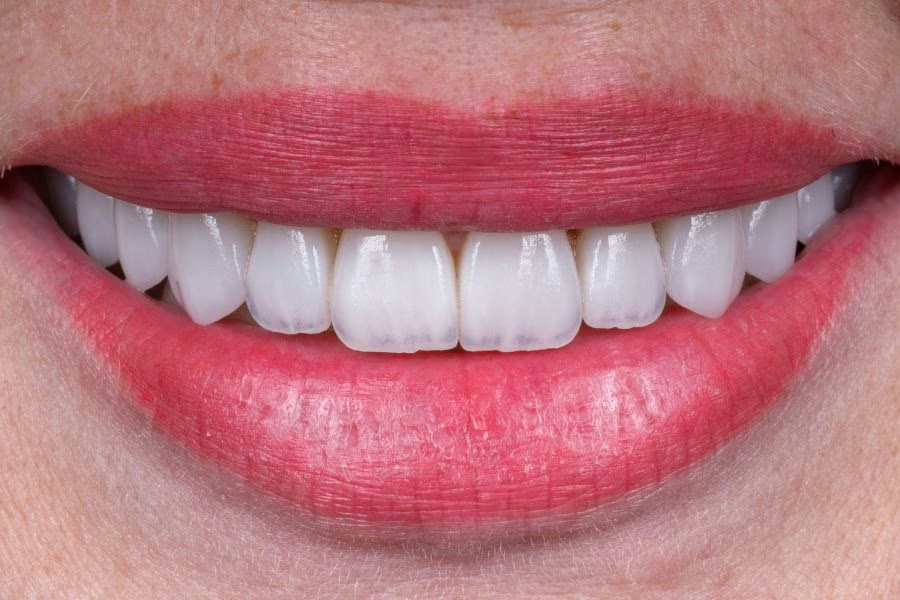
Composite bonding: common questions about durability, contraindications, how it differs from veneers and the procedure. Flow Dental Studio, Gdynia.
Read more
Composite bonding without the gloss: durability, limitations, care and situations where veneers are the better choice. Flow Dental Studio, Gdynia.
Read more
Veneers or crowns? How much tooth is filed down, durability, indications and price, and which to choose after a root canal or when a tooth is missing.
Read moreTell us what you would like to improve about your smile, and we will call you back to arrange a consultation with a smile design in Gdynia.
Flow Dental Studio
ul. Arkadiusza Rybickiego 2B/U2, 81-340 Gdynia
+48 786 420 004
info@flowdentalstudio.pl
Monday – Friday, 9:00 – 20:00