
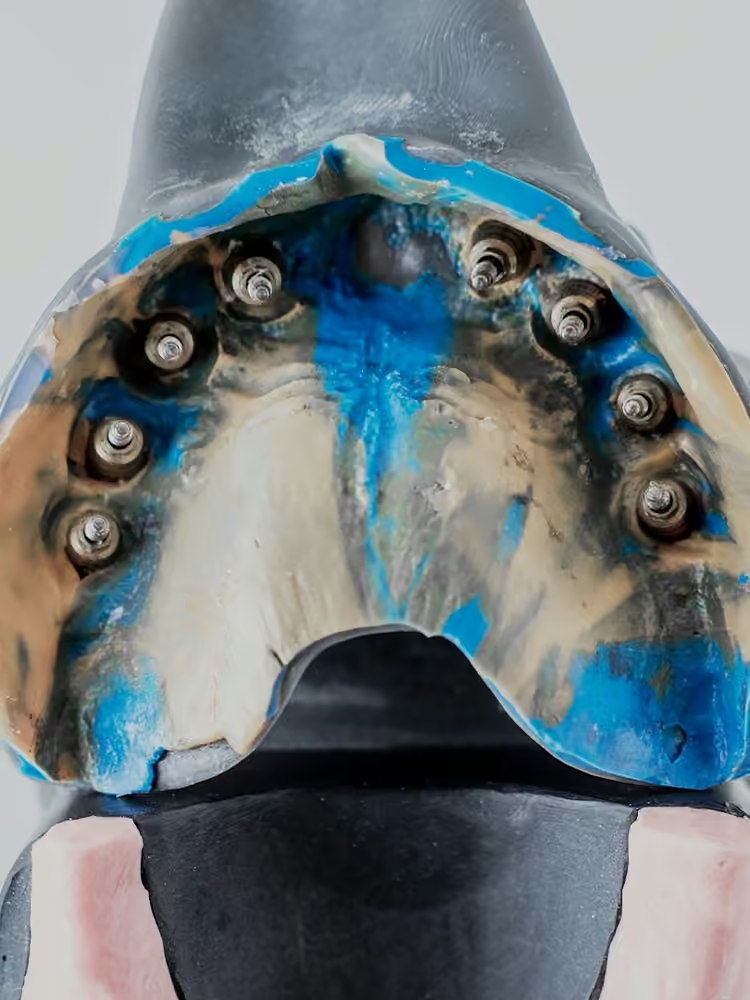
Implant surgical guides in Gdynia - 3D navigation
An implant surgical guide is a custom 3D-printed surgical template that precisely guides the drills and the implant exactly where it was planned digitally. At Flow Dental Studio in Gdynia we design surgical guides based on a CBCT scan and an intraoral scan, and then print them on site. This makes the procedure more predictable, less invasive and shorter.
Book an implant consultation in Gdynia – tel. +48 786 420 004
4.9/5 43 reviews on Google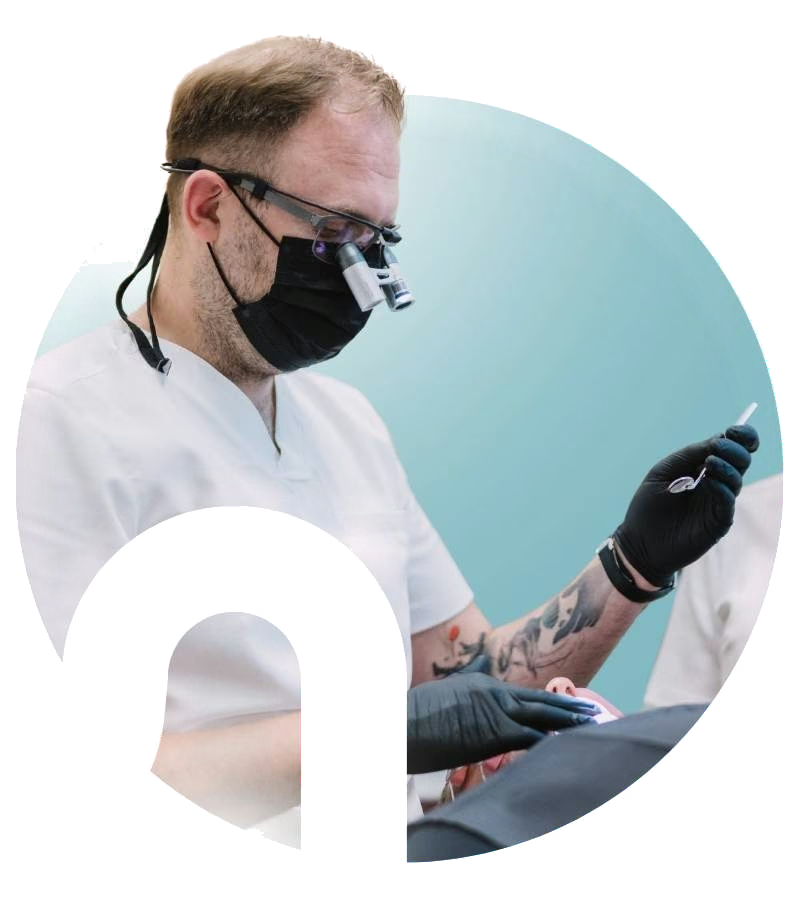
-
3D navigation based on CBCT and an intraoral scan
-
Printed on site SprintRay Pro 2 printer
-
Often flapless less swelling, faster healing
-
Consultation 200 PLN with a digital treatment plan
How can you tell whether a guided implant is right for you?
I'm afraid the implant will end up too close to a nerve or the sinus.
I need several implants and precision matters to me.
I want the procedure to be as short and minimally invasive as possible.
I'd like temporary teeth as soon as possible after the procedure.
I'd rather know where the implant will go before I sit in the chair.
If any of these sounds like you, a guide transfers the plan prepared on the CBCT scan and intraoral scan to the procedure. Whether you need one is decided by the dentist after analysing the CBCT scan.
How can we help?
The concerns that most often hold people back, and how we address them.
“I'm afraid the implant will be placed crooked.”
If precision matters to you: the guide directs the instruments according to a plan prepared on the CBCT scan and intraoral scan. We plan the implant position around the future crown, not just the amount of bone.
“I'm worried about having my gum cut and stitched.”
If you are worried about tissue intervention: with the technique that avoids cutting the gum, often only a small opening is made, with no stitches. Less intervention means less swelling and faster healing.
“I don't want a long procedure.”
If time in the chair matters to you: measurements and planning are done before the procedure. A single implant can sometimes be placed with a guide in under twenty minutes.
“I don't know whether a guide suits my situation.”
If you are not sure: the guide is made from a digital scan of your teeth and gums and rests on the teeth, gum or bone. Whether it is used is decided by the dentist after analysing the CBCT scan.
Implant surgical guides: the process at a glance
You will find a full description of each stage further down the page. Here is the shortest version of what to expect.
How does the guide protect the nerves and the maxillary sinuses?
The guide protects the nerves and sinuses because, at the planning stage, all the important anatomical structures are located on the CBCT image. The guide physically limits the path of the drill, so the procedure is carried out as safely as possible. Above all, it protects the inferior alveolar nerve, the floor of the maxillary sinus and the roots of the neighbouring teeth.
To avoid breaching the sinus floor, the implant must be the right length for the bone - digital planning allows this length to be set before the procedure. The guide also helps keep a safe distance from the roots of the neighbouring teeth. Planning the procedure this way reduces the risk of complications and of injury to the soft tissues around the implant.
Above all, the guide protects:
- the inferior alveolar nerve,
- the floor of the maxillary sinus,
- the roots of the neighbouring teeth.
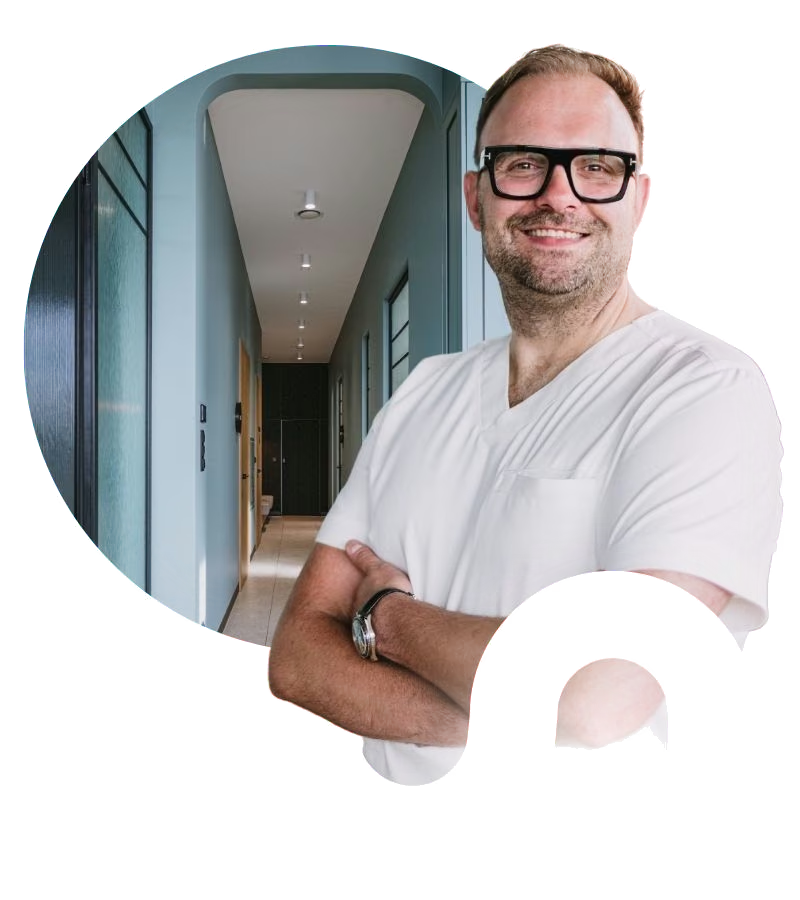
Our team with implantologist Adrian Kiepuszewski
Digitally navigated procedures are carried out by our team with implantologist Adrian Kiepuszewski, who has more than 16 years of experience, including complex full-arch cases. We prepare every guide and treatment plan individually - from diagnostics, through the procedure, to a custom-fitted crown or bridge.
- Implantology
- 3D navigation
- Full-arch restorations
- CBCT
- coDiagnostiX
- SprintRay Pro 2
How much does an implant surgical guide cost in Gdynia?
The price of an implant surgical guide in Gdynia is set individually and forms part of the overall implant treatment plan. It is not the cost of the implant itself, but a fee for digitally planning the procedure and making a custom surgical guide. We give you an exact quote after an implant consultation, which costs 200 PLN.
Guide priced individually, as part of the treatment plan
You can spread the cost of treatment in instalments.
See the full price list“What sets Dr Adrian apart is not only his exceptional skill and precision, but above all a rare respect for the patient's boundaries and feelings.”
See why they chose Flow Dental Studio. The reviews come from our Google Business Profile.

Very professional and friendly. A visit to the dentist can be a pleasant experience after all. The aligners are comfortable and hygienic, and week by week I can see my teeth straightening. I recommend it.
Translated from Polish
I had the pleasure of being treated by Dr Kiepuszewski at Flow Dental Studio, and I can honestly say he is an exceptional dentist. Wisdom tooth extraction, which so many patients dread, took place in a comfortable atmosphere. Dr Adrian is not only extremely competent but also has a wonderful approach to patients, full of understanding and care. I also decided on aligner treatment. The doctor's precise work and professionalism mean the visits run smoothly and in a pleasant atmosphere. My smile looks better and better, and I know it was the best decision. I recommend him to anyone who dreams of straight teeth without pain or discomfort! The Flow Dental Studio practice itself also deserves a special mention. Modern equipment, a beautiful interior, a pleasant atmosphere and kind, courteous staff make patients feel looked after, and the visit becomes a much more pleasant experience. It is a place that cares not only about healthy teeth but also about the patient's wellbeing.
Translated from Polish
Flow Dental Studio is a place where professionalism goes hand in hand with empathy and care for the patient. I had professional teeth cleaning and fillings there, and I am very impressed by the precision and gentleness of the treatment. Dr Julia and Daria explain everything thoroughly, and the atmosphere at the practice is calm and friendly. It is definitely a practice you can trust completely, which is why I will be back whenever the opportunity arises :)
Translated from Polish
Beautiful practice, professional staff, and the doctor is the GOAT. I didn't even notice when it was over – the nasty wisdom tooth is gone. Highly recommended.
Translated from Polish
It is rare to find places where professionalism goes hand in hand with genuine empathy — but Flow Dental Studio is exactly that kind of place. I had the pleasure (yes, it really can be called that!) of being in Dr Adrian's care for a wisdom tooth extraction I had been dreading for a long time because of severe hypersensitivity. What sets Dr Adrian apart is not only his exceptional skill and precision, but above all his extraordinary respect for the patient's boundaries and feelings. Every gesture and every word – full of calm, understanding and attentiveness – made me feel cared for at every stage of the procedure. A procedure that had filled me with fear turned out to be an almost... soothing experience. No pain, no tension, and great attention to my mental and physical comfort. This is not just dentistry at the highest level — it is the art of creating a safe space in a place usually associated with stress. From the bottom of my heart, thank you to Dr Adrian and the whole Flow Dental Studio team for making it possible to come to you anxious — and leave grateful and smiling.
Translated from Polish
I recommend Dr Adrian. A very professional approach to patients.
Translated from PolishFrequently asked questions about implant surgical guides
Can an implant be placed using a guide?
How does the guide fit the patient's mouth?
Does a guide shorten implant placement?
Does guided surgery require stitches?
What role does the guide play in digital dentistry?
How long does an implant take to heal?
What happens at an implant consultation?
We start with diagnostics and an assessment of your situation - you see the digital treatment plan and cost estimate before the procedure.
Book a consultation- 3D diagnostics - a CBCT scan and an intraoral scan.
- Digital plan - the implant position planned around the future crown.
- Plan and cost estimate - the guide priced within the overall treatment plan.
- No obligation – you decide once you have seen the plan.
Implant surgical guides at a glance
An implant surgical guide transfers the digital treatment plan to the patient's mouth with a high degree of accuracy.
It allows the implant to be placed in the planned position, as safely as possible for the nerves and sinuses.
It often makes it possible to operate without cutting the gum (flapless), which means less swelling and faster healing.
The procedure is done under local anaesthetic and can be shorter - a single implant can be placed in under twenty minutes.
In selected cases it allows temporary teeth on the same day (immediate loading).
A full digital workflow at our practice in Gdynia: CBCT scanner, TRIOS 5 scanner, planning and a 3D printer.
What is an implant surgical guide?
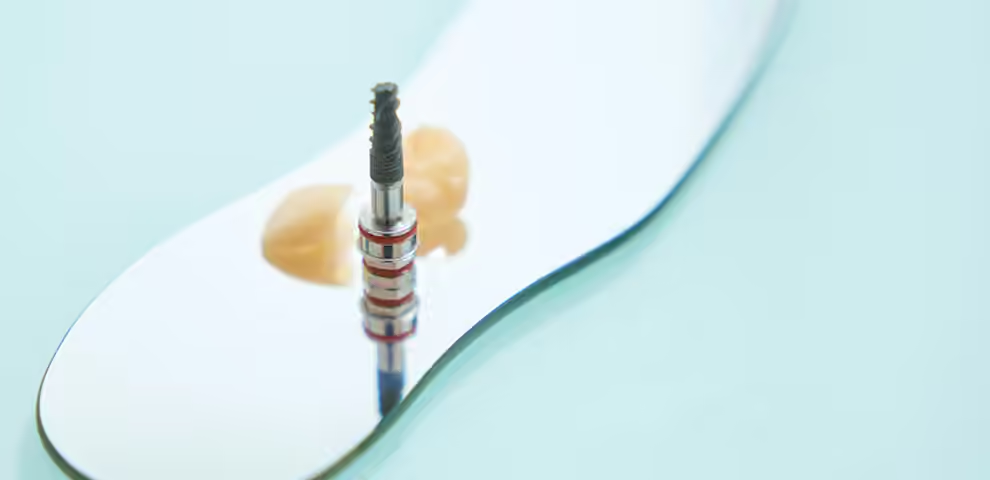
An implant surgical guide is a custom-designed, 3D-printed surgical template that acts as a precise guide for the drills during implant placement. Its job is to transfer the digital treatment plan accurately to the patient's mouth. The guide ensures the instruments are directed precisely according to the design prepared in advance.
The surgical guide rests on the teeth, gum or bone and securely fixes the position, angle and depth of the implant. Using a guide means that instead of working “freehand”, the dentist reproduces the planned layout, which reduces uncertainty during the procedure. This tool brings diagnostics, planning and execution together in one coherent process.
A digital treatment plan, transferred to the mouth and turned into a precise guide that sets the position, angle and depth of the implant.
Why does a guide make implant treatment smoother?
A guide makes implant treatment smoother because all the difficult planning is done in advance, on a digital model, rather than during the procedure. The dentist transfers the finished plan to the mouth, so the implant position is predictable and repeatable. It is a real gain in precision and safety in implant treatment.
In implant treatment, what matters is not only the implant itself but also its position relative to the future crown. Prosthetic-driven planning starts by visualising the end result and only then chooses the implant position to match it. This way of working also shortens treatment and makes it more predictable.
What are the benefits of treatment with an implant surgical guide?
The benefits of treatment with an implant surgical guide rest on three pillars: precision, safety and comfort. They affect every stage - from planning to healing. At Flow Dental Studio in Gdynia we focus on making the procedure as precise and safe as possible.
Precision and predictability. Digital planning allows the implant to be placed in the right position to within tenths of a millimetre. This translates into a well-fitting future crown and a natural-looking gum around it.
Safety. The guide directs the drill as safely as possible for the nerves, sinuses and neighbouring teeth, which have been mapped beforehand on the CBCT scan.
Comfort and a shorter procedure. A less invasive procedure means greater comfort, less swelling, shorter treatment and faster healing.
Each of these elements affects the end result and how the patient feels. The combination of precision, safety and comfort makes digitally navigated implant placement one of today's proven solutions for restoring teeth.
How is a surgical guide made?
Making a surgical guide is a fully digital process in three stages: diagnostics, planning and 3D printing. The whole process, from the diagnostic visit to a finished, sterile guide, usually takes from a few to around 7 working days. Each stage combines precise planning with the safe manufacture of a custom tool.
Digital diagnostics - intraoral scan and CBCT scan
Digital diagnostics combines scanning the mouth with a CBCT scan. Before planning, we take a CBCT scan and a TRIOS 5 intraoral scan, which creates an accurate 3D colour model of the teeth and gums, while the CBCT scan provides a three-dimensional image of the bone and the details of its anatomy. Combining the two images gives a complete digital model of the patient.
The model also shows changes in the bone resulting from various physiological processes, so planning is based on the current situation. The scan covers both the lower and upper jaw, and the image captures hard and soft tissues without traditional impressions. Data prepared in this way forms the basis of the whole plan.
Virtual planning of the procedure
On the digital model, the dentist places a virtual implant, choosing its size, position and angle. Before the procedure begins, he analyses the thickness of the bone and how close the anatomical structures are, and plans the implant position around the future crown. You can see and approve the end result before anything is done in your mouth.
This is the stage at which the whole procedure is precisely planned and the future prosthetic restoration is digitally designed. The visualisation makes it easier to understand the course of treatment and to make a decision. Only once the plan is approved does the design go to print.
3D printing the guide
Once the plan is approved, the guide design goes to the 3D printer. The guide is built layer by layer from biocompatible medical resin, then cured with UV light, cleaned and sterilised. Thanks to the accuracy of the print, the finished guide fits securely over the teeth and gums in the patient's mouth.
At Flow Dental Studio in Gdynia we print the guide on site, on a SprintRay Pro 2 3D printer. Printing on site shortens waiting times and gives us control over quality at every stage.

What does guided implant placement involve?
Guided implant placement follows a plan set in advance and is carried out under local anaesthetic. After the anaesthetic, the dentist secures the guide on the teeth or gum and then places the implant through the sleeves in the guide into the pre-planned position. The implant goes exactly where it was planned, with no additional measurements during the procedure. As a result, implant surgery at our dental practice in Gdynia is efficient and predictable.
It is often possible to use a technique that does not require cutting the gum (flapless) - instead of an incision, the surgeon makes a small opening in the right place. This means less bleeding, less swelling and faster healing. The whole procedure of placing a single implant can take under twenty minutes, which shortens your time in the chair.
Implants in one day - when are temporary teeth possible?
Temporary teeth on the same day are possible in selected cases, when the implant achieves sufficient primary stability. The precise, predictable implant position achieved with the guide then allows it to be loaded with a temporary restoration straight after the procedure. The dentist decides whether you are eligible after assessing your bone and general health.
This temporary restoration recreates the appearance and basic function of the teeth, so you are not left without teeth during healing. It is not the end of treatment - the final bridge or crown is made after healing and osseointegration, which usually takes 3-6 months. During this time the temporary teeth serve as an interim solution, without a removable denture.
When are implant surgical guides used?
Implant surgical guides are helpful in almost any implant treatment, but in some situations they are particularly recommended. These include restorations in the aesthetic zone, treating patients with no teeth with a full-arch restoration on implants, difficult anatomical conditions and placing several implants parallel to each other.
The aesthetic zone. When restoring a single front tooth, every millimetre affects the result - a guide can be the ideal solution here, as it helps achieve a natural gum contour.
Implant treatment for patients with no teeth. In a full-arch restoration, several implants must be positioned parallel to each other; this is a condition for fitting a bridge screwed onto the implants and an alternative to a removable denture.
Difficult anatomical conditions. A small amount of bone close to a nerve or the sinus calls for particularly careful planning.
Bone conditions vary and change over time, which is why the plan is always based on an up-to-date CBCT scan. In each of these cases, a guide makes treatment more predictable and safer.
How does navigation differ from conventional dental implant placement?
Digital navigation differs from conventional dental implant placement mainly in that the implant position is set by a digital plan rather than judged “by eye” during the procedure. This gives greater repeatability, a shorter and less invasive procedure, and better protection of anatomical structures.
- The gum is cut and lifted to expose the bone
- Many decisions are made only during the procedure
- Position judged “by eye” during the procedure
- The implant position is set by a digital plan
- Decisions made in advance, on a model
- A shorter, less invasive procedure (often flapless)
- Better protection of anatomical structures
With the conventional method, the dentist more often has to cut and lift the gum to see the bone, and many decisions are made only during the procedure. With navigation, these decisions are made in advance, on a model. The difference lies in precision, time, invasiveness and the predictability of the aesthetic result.
Implant surgical guides at Flow Dental Studio in Gdynia
At Flow Dental Studio in Gdynia we run a full digital workflow on site - from the NewTom Giano HR CBCT scanner and the TRIOS 5 scanner, through planning in coDiagnostiX software, to printing the guide on a SprintRay Pro 2 3D printer. This gives us control over quality at every stage and shortens treatment time.
What affects the cost of an implant surgical guide?
Several factors affect the cost of an implant surgical guide, because each guide is made to measure for a particular case. What matters most is the number of implants planned and the size of the guide, how complex the anatomical conditions are, what the guide rests on (teeth, bone or gum) and the scope of the design work. A guide for one implant is simpler than a guide for implant treatment in a patient with no teeth.
Plan your treatment with 3D navigation
We will assess your situation, prepare a digital plan and give you a cost estimate - with no obligation.
Read before you decide
Are dental implants safe? Contraindications, the healing process, the most common complications and symptoms that mean you should contact your dentist.
Read more
What does an implant really cost? Placement from 3400 PLN, crown on an implant 4500 PLN. We break down the price before you decide.
Read more
Cheap implants and long-term cost: how implant quality, 3D diagnostics and planning affect how long treatment lasts and the risk of costly corrections.
Read moreBook an implant consultation in Gdynia
An implant consultation at Flow Dental Studio means diagnostics and an assessment of your situation, on the basis of which we prepare a digital treatment plan and cost estimate - with no obligation. Book an appointment to find out whether guided treatment is the right solution for you.
Flow Dental Studio
ul. Arkadiusza Rybickiego 2B/U2, 81-340 Gdynia
+48 786 420 004
info@flowdentalstudio.pl
Monday – Friday, 9:00 – 20:00